
News
Hebron Mayor Speaks Out as Israel Increases West Bank Presence
Palestinians claim that Israel’s actions are limiting their involvement in decisions related to planning and development in the West Bank.
A senior Palestinian official in the West Bank has expressed concerns that Israel's recent expansion of control in the region may mark the end of the road for Israeli-Palestinian negotiations, citing the significant impact on the peace process.
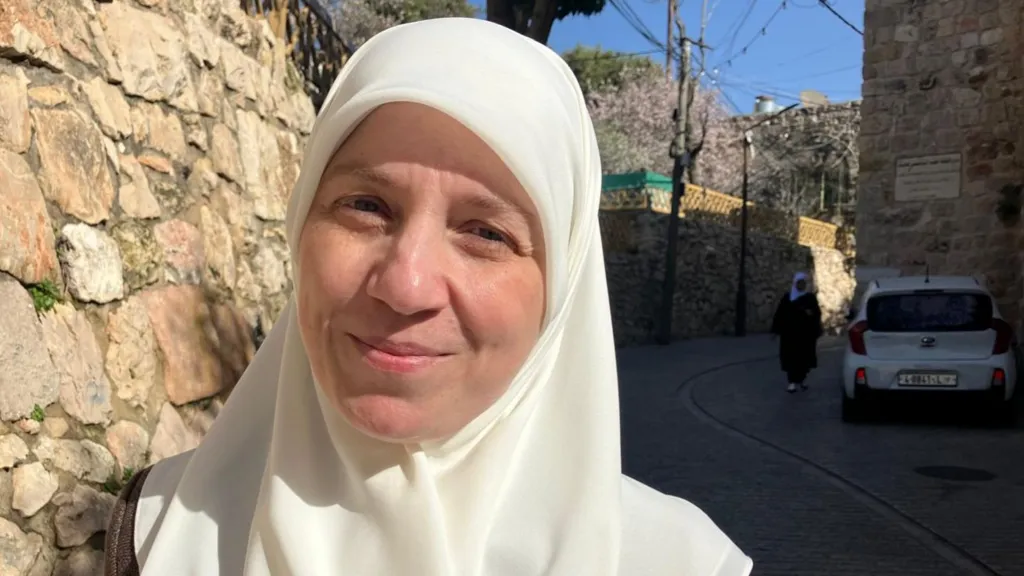
Asma al-Sharabati, the acting mayor of Hebron, has stated that new legislation announced by Israeli cabinet ministers will effectively exclude Palestinian authorities from decision-making processes related to urban planning and development, even in areas currently under Palestinian control.
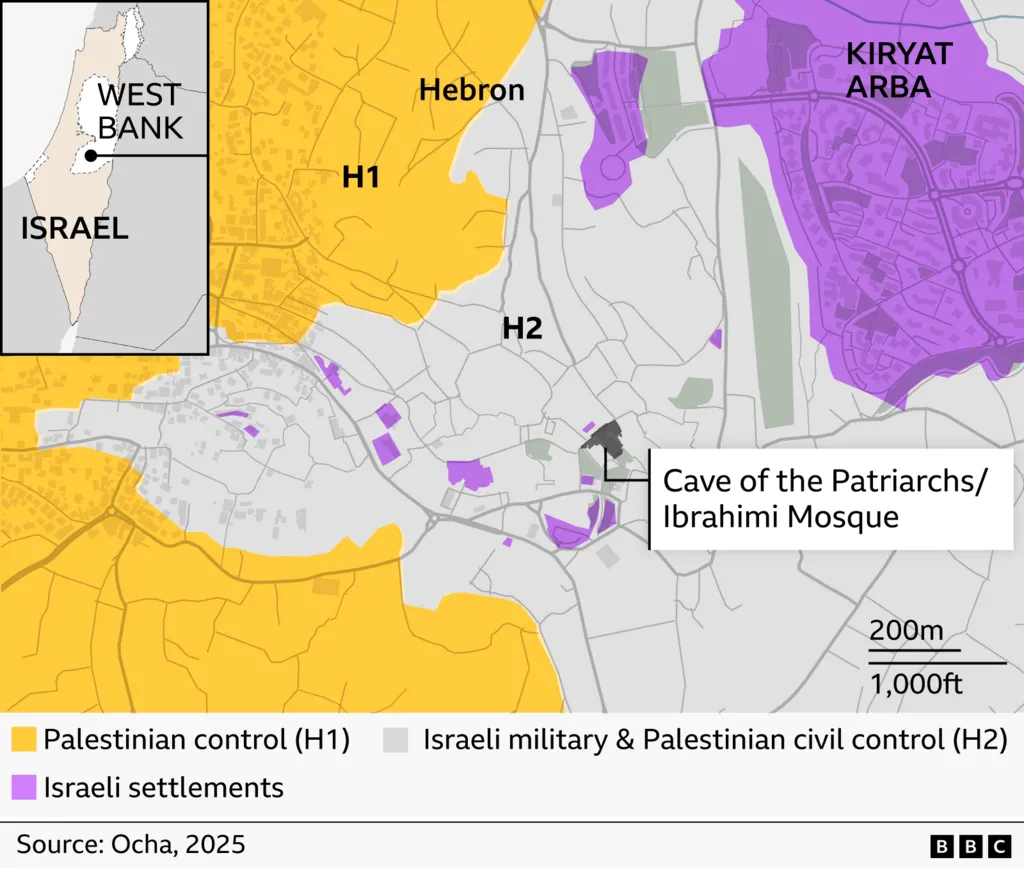
Hebron, a city in the West Bank, is a frequent site of tensions, with Israeli soldiers stationed to protect hundreds of Israeli settlers living among Palestinians in a heavily militarized area.
On Sunday, the Israeli security cabinet approved significant changes to the division of powers in the West Bank, which was established over three decades ago under the US-backed Oslo Accords, signed by both Israeli and Palestinian leaders in 1993.
The changes include the expansion of Israeli control over municipal services in Palestinian-run areas, as well as the transfer of authority to manage so-called "heritage sites" across the West Bank, citing the need to protect water, environmental, and archaeological resources.
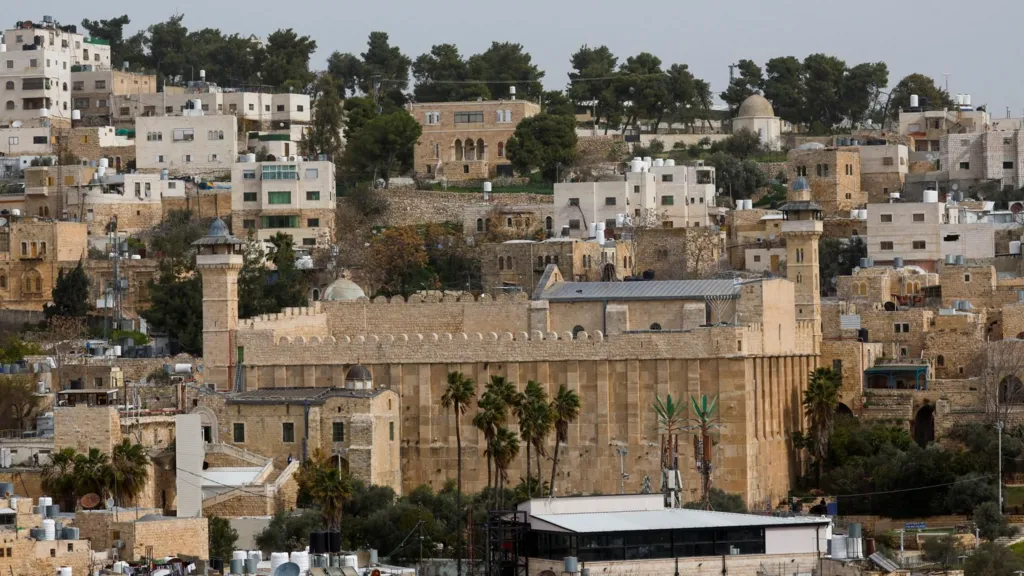
Israel has also announced plans to assume control over the planning authority at the Cave of the Patriarchs in Hebron, a site of great significance in Judaism, located within the Ibrahimi Mosque.
According to al-Sharabati, the new measures will enable Israel to unilaterally declare any building or site as "ancient" and take control of it, effectively bypassing Palestinian authorities in urban planning and development decisions.
Al-Sharabati stated that she had not received formal notification of Israel's plans and was instead gathering information from Israeli news sources.
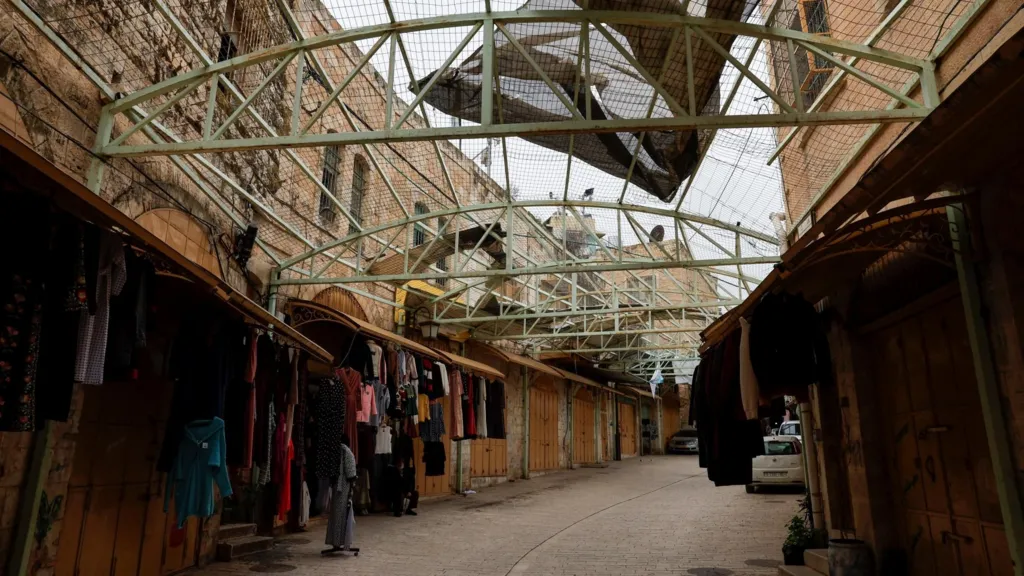
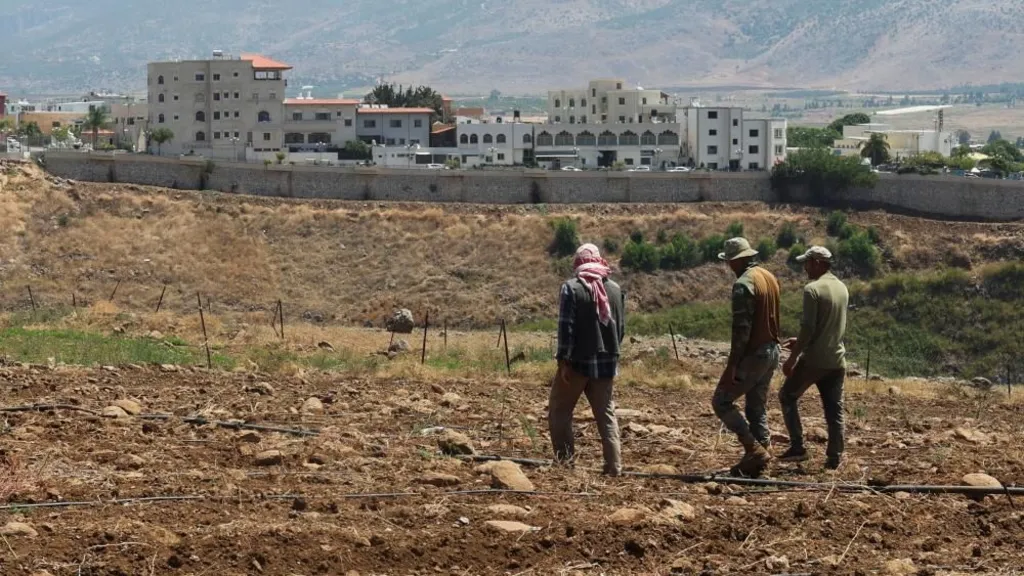
A short distance from Hebron's bustling market, a heavily fortified Israeli checkpoint marks the boundary between the city and a nearby area, where Palestinian shops are closed, and streets are restricted to protect Israeli settlers.
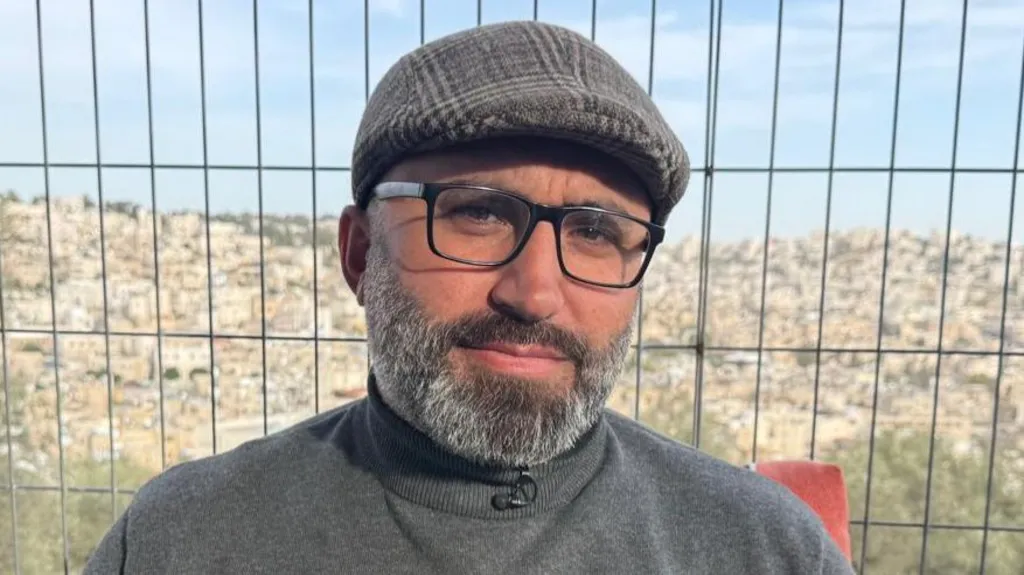
Palestinian activist Issa Amro resides in this volatile area, known as H2, which is characterized by a complex and winding route through Palestinian homes and stony pathways.
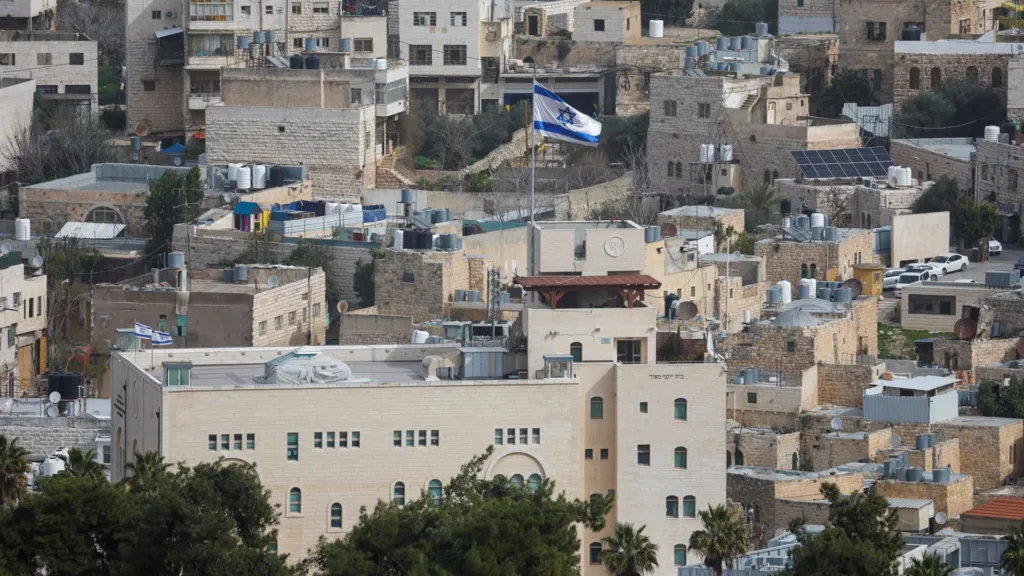
During a visit to Amro's home, an ultra-Orthodox Jewish couple was seen picnicking under the trees outside, while a local settler emerged from a nearby house and followed the group for a short distance.
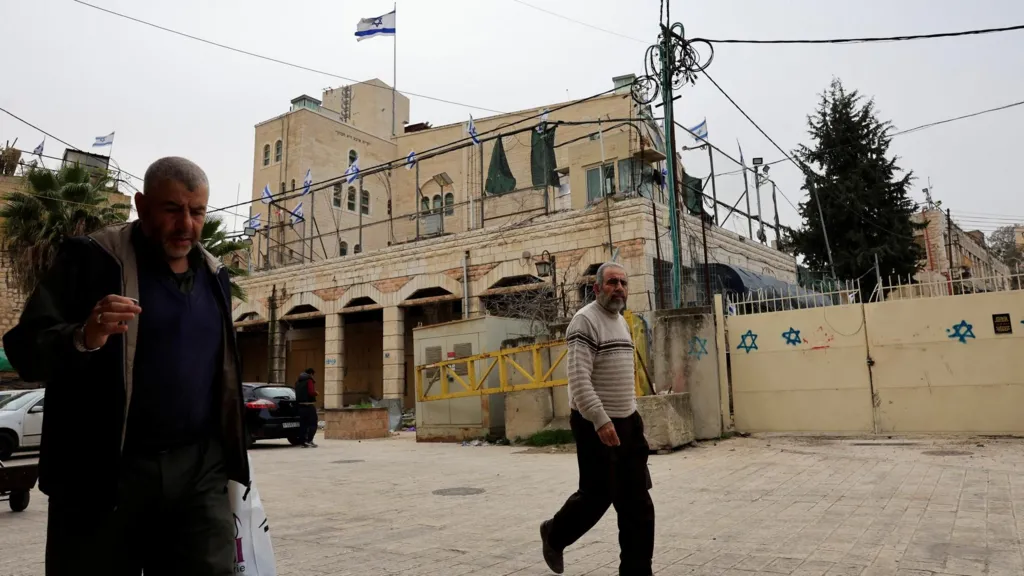
Inside Amro's house, a plaque reading "Free Palestine" is displayed, while a large Israeli flag can be seen flying over the streets below.
Amro pointed out nearby Palestinian buildings that have been evacuated due to years of tension and expanding Israeli control.
However, Amro believes that the latest changes represent a significant shift, stating that Israel is now formalizing its control through legal means.
"Previously, they were expanding without a legal basis," Amro said. "Now, they will be the law. They are changing the status from Occupied Territories to a legal dispute, effectively annexing the land without granting me, as a Palestinian, any rights."
Israel plans to begin providing municipal services to Jewish settlers in Hebron and allow private Israeli citizens to purchase land across the West Bank, a move that is prohibited under both Jordanian and Palestinian law.
Palestinians who have sold property to Israelis in the past may face risks due to Israel's planned publication of classified land registry information.
The social stigma associated with selling property to Israelis is deeply ingrained, reflecting the complexities of the Israeli-Palestinian conflict.
Jibril Moragh, a resident of Hebron, recounted an incident 18 years ago when he refused an offer from a group of Israelis to purchase his house near the Ibrahimi Mosque.
"One of them offered me 25 million shekels, but I refused," Moragh said. "The man was willing to pay any price, and even allowed me to continue living in the house, but I would not sell to the occupation."
Over 700,000 Israeli settlers reside in the occupied West Bank and annexed East Jerusalem, territories captured by Israel from Jordan in the 1967 Middle East War, which Palestinians claim as part of their future independent state, along with the Gaza Strip.
The construction of Israeli settlements in these areas is considered illegal under international law.
The recent expansion of Israeli control over the West Bank, particularly in the aftermath of the 7 October 2023 Hamas attacks on Israel and the subsequent war in Gaza, marks a significant shift in Israel's policies towards the region.
Finance Minister Bezalel Smotrich, who oversees settlement policies, stated that the new measures aim to "deepen our roots in all parts of the land of Israel" and effectively rule out the possibility of a Palestinian state.
Zvi Sukkot, a lawmaker in Smotrich's far-right Religious Zionism party, expressed his expectation of full Israeli sovereignty over the region, emphasizing the need to protect Israel's heritage and environmental resources, even in Palestinian-run areas.
The latest changes not only undermine the agreements signed by Israel decades ago but also erode the remaining powers of the Palestinian Authority, which was slated to take over power from Hamas under Donald Trump's peace plan.
Hebron's mayor, al-Sharabati, expressed her concerns, stating that Palestinians are not protected and that institutions are failing to safeguard their rights, while the international community focuses on the Gaza Strip and its associated humanitarian crises.
Palestinian President Mahmoud Abbas has called for a firm response from the US government, arguing that Israel's decision disrupts Trump's efforts in the region and violates international law.
To date, President Trump has only reiterated his opposition to Israel's formal annexation of the West Bank, without providing further comment on the recent developments.
Several countries, including the UK, have recognized a Palestinian state, and in response to Israel's assumption of civilian powers in Palestinian-controlled territory, the UK government has been asked to clarify its stance.
Under-Secretary of State for the Middle East Hamish Falconer stated that the UK government would provide further comment in the coming days, emphasizing that the decision is widely regarded as a significant mistake.
"We strongly condemn the decision and expect to see it reversed," Falconer said, echoing the sentiments of many of Israel's allies.
The expansion of Israeli control in the West Bank has continued, even as international attention remains focused on the Gaza Strip.
However, Trump's plan for Gaza relies on the support of Arab countries, many of which are demanding progress towards a Palestinian state, highlighting the interconnectedness of the region's conflicts.
Developments in Hebron and the West Bank may still have a significant impact on Trump's vision for Gaza and the broader Middle East peace process.
Additional reporting was provided by Yousef Shomali and Rebecca Hartmann.


News
Bhatia and Hisatsune Take the Lead, McIlroy Faces Uphill Battle
At the AT&T Pebble Beach Pro-Am, Akshay Bhatia carded a 64, eight under par, to move into a tie for second-round lead with Ryo Hisatsune, both players sitting at 15 under.
Rory McIlroy trails the leaders by six strokes as the tournament heads into the weekend, following a second round that saw him card a 67.
The current standings at the AT&T Pebble Beach Pro-Am after round two are as follows:
A Bhatia (US) and R Hisatsune (Jap) are tied at the top with a score of -15, while R Fowler (US) and S Burns (US) are one stroke back at -14, and MW Lee (Aus), S Straka (Aut), and J Bridgeman (US) are at -12.
Other notable players include M Fitzpatrick (Eng), K Bradley (US), H Matsuyama (Jap), J Spieth (US), and X Schauffele (US) at -10, T Fleetwood (Eng) and R McIlroy (NI) at -9, S Lowry (Ire) at -8, S Scheffler (US) at -6, and J Rose (Eng), H Hall (Eng), and R MacIntyre (Sco) at -5.
Akshay Bhatia's impressive eight-under-par 64 has earned him a share of the lead with Ryo Hisatsune, both sitting at 15 under par.
Defending champion Rory McIlroy finished his second round with a birdie, signing for a 67, but remains six strokes off the pace.
McIlroy's round was marked by five birdies and an eagle, but he was hindered by bogeys on the 10th and 14th holes, before closing with a strong four on the par-five 18th.
Earlier in the day, Akshay Bhatia had posted one of the top rounds at Spyglass Hill, while Ryo Hisatsune recovered from a mid-round slump to pick up four shots in his final five holes.
Rickie Fowler has moved into a tie for second place alongside Sam Burns, with a score of 14 under, as he seeks his first victory since July 2023.
Sepp Straka of Austria is the highest-placed European player at 12 under, with England's Matt Fitzpatrick two strokes back, alongside a group including Keegan Bradley, Jordan Spieth, and Xander Schauffele.
Tommy Fleetwood of England followed his opening 67 with a 68 to join Rory McIlroy at nine under, while Shane Lowry of Ireland is one stroke behind.
Scottie Scheffler has rejuvenated his chances with a strong stretch of three birdies and an eagle on five holes after the turn, bringing him to six under par.
Justin Rose and Harry Hall of England, along with Scotland's Robert MacIntyre, are currently at five under par, with each player having completed one round at both Pebble Beach and Spyglass Hill.
The remaining rounds will be played exclusively at Pebble Beach, with no 36-hole cut in place at the $20m (£14.7m) PGA Tour event.
News
Gordon Ramsay believes Beckham family will overcome their issues with time
Following a reported disagreement with his parents, Sir David and Lady Victoria Beckham, the celebrity chef advised Brooklyn to consider a future time when his mother and father would no longer be present, saying “one day you’re not going to have your Mum and Dad”.
Gordon Ramsay has come to the defense of Sir David and Lady Victoria Beckham, describing them as "good parents" and expressing confidence that time will help mend their relationship with their son Brooklyn, following a highly publicized family dispute.

In an interview with the Sun, Ramsay, a longtime friend of the Beckham family, praised Brooklyn for carving out his own path in life, showing admiration for the young man's independence.
Brooklyn Beckham sparked widespread attention in January with a series of Instagram posts, in which he revealed that he had no interest in reconciling with his family, amid months of speculation about a potential feud.
The posts included several allegations against his parents, primarily related to his wedding to American actress Nicola Peltz, the daughter of a wealthy businessman; the Beckhams have not publicly responded to these claims.
One of Brooklyn's most striking allegations was that his mother had commandeered the first dance at his wedding, which he claimed had been meticulously planned in advance to a romantic ballad.
Brooklyn described the incident as deeply uncomfortable and humiliating, stating that his mother's behavior had made him feel uneasy in front of their guests.
However, a report from British Vogue, which had a presence at the wedding, offered a differing account, noting that Brooklyn had invited his mother to join him on stage for a dance, and that they were later joined by his father and younger sister, Harper.
Gordon Ramsay, who attended the wedding, countered Brooklyn's allegations in his interview with the Sun, asserting that nothing untoward or salacious had occurred during the event.
Ramsay emphasized the strong bond between David and Brooklyn, highlighting the depth of their relationship and the love that David has for his son.
The chef expressed optimism that Brooklyn would eventually reflect on his actions, suggesting that it was only a matter of time before he reevaluated his behavior.
Ramsay cautioned that it is easy to get caught up in the intensity of the moment, but ultimately, things will return to normal.
When asked if he had been in touch with Brooklyn, Ramsay revealed that they had exchanged a few messages, and that he holds a deep affection for the young man.
Ramsay described Brooklyn as eager to establish his independence, but urged him to remember that his parents will not always be there to support him, emphasizing the importance of maintaining a strong family bond.
Ramsay's comments came as he prepares for the release of his new Netflix documentary, Being Gordon Ramsay.
While Sir David has not directly addressed the family dispute, he did offer some general thoughts on social media in January, noting that children should be allowed to make mistakes and learn from them.
News
Bangladesh’s New Leader Faces Challenge of Delivering Reform After Landslide Election Victory
Bangladesh is poised to have Tarique Rahman as its next prime minister, a development that comes 18 months following the removal of the country’s longest-serving leader amid widespread demonstrations.
It has been over two years since Sheikh Hasina's election victory, which was widely criticized as being unfairly influenced in her favor. At the time, it seemed unlikely that her 15-year hold on power would be disrupted so suddenly, or that a rival party, which had been largely dismissed, would make such a significant comeback.
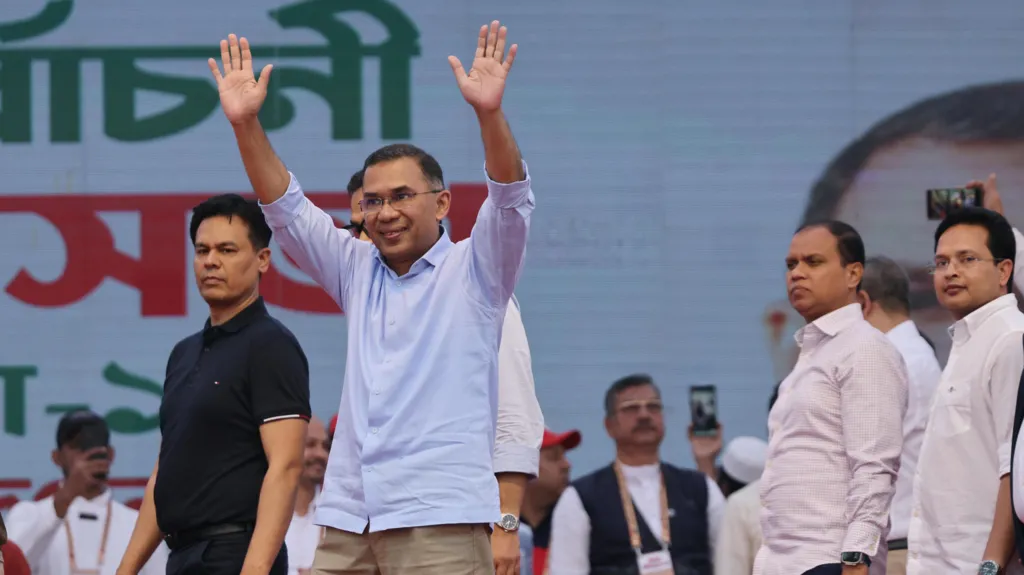
However, in the context of Bangladeshi politics, this shift is merely another instance of the alternating pattern of power between Hasina's Awami League and the Bangladesh Nationalist Party (BNP), which have been trading power for decades.
This marks the first time that Tarique Rahman, the new leader of the BNP, has formally led the party and contested an election.
His mother, Khaleda Zia, who passed away late last year, had led the party for four decades, taking over after the assassination of his father, Ziaur Rahman, the founder of the BNP and a key figure in Bangladesh's war for independence.
Tarique Rahman has faced allegations of corruption and benefiting from nepotism during his mother's tenure. He returned to Bangladesh five days before her death, ending his 17-year self-imposed exile in London.
Although Rahman, 60, has occasionally acted as the de-facto chair of the BNP when his mother was imprisoned or ill, he is largely viewed as an untested leader.
According to political scientist Navine Murshid, Rahman's lack of experience may actually work in his favor, as people are willing to give change a chance and are hopeful for positive outcomes.
The BNP's primary objective is to restore democracy in Bangladesh, according to the party.

Senior BNP leader Amir Khasru Mahmud Chowdhury stated that the party's first priority is to rebuild the country's democratic and financial institutions, which have been damaged over the past decade.
Bangladesh has a history of broken promises, with parties often becoming increasingly authoritarian after coming to power.
However, the country's young people, who played a key role in the "July uprising" of 2024 that led to Hasina's ouster, appear less willing to accept the status quo this time around.
Tazin Ahmed, a 19-year-old who participated in the uprising, expressed her desire for a better future, stating that the real victory will be when the country is free from corruption and has a stable economy.
Ahmed emphasized that the resignation of the previous prime minister was not the ultimate goal, but rather a step towards achieving a corruption-free and prosperous Bangladesh.
Her cousin, Tahmina Tasnim, 21, echoed similar sentiments, calling for unity among the people and a stable nation with a strong economy, and warning that they will not hesitate to take action if necessary.
Since Hasina's departure, Bangladesh's interim leader, Mohammad Yunus, has struggled to maintain law and order.

The new government will need to prioritize restoring law and order, as well as addressing the country's economic challenges, including high food prices and unemployment among the large youth population.
Sociologist Samina Luthfa noted that the lack of experience in governing is a challenge faced by all parties.
The Islamist Jamaat-e-Islami, which has been banned twice in Bangladesh's history, including during Hasina's tenure, has won a significant number of seats in this election.
The National Citizens Party (NCP), a new party formed by some of the students who led the uprising, has won six seats in its first election.
Luthfa observed that the incoming parliament will feature many new leaders who have never held office before.
She noted that the NCP's young members have a lot to learn, while the more experienced politicians lack experience in governing the country, making it a challenging task ahead.
Jamaat's election manifesto focused on secular and development-oriented policies, with no mention of Islamic law.

However, the party's website suggests that its ultimate goal is to implement Islamic law, which has raised concerns about its intentions if it were to come to power.
Murshid stated that Jamaat's performance in the election was not unexpected, given its strong organization and grassroots efforts over the years.
She acknowledged that Jamaat is a well-organized party, but also expressed concerns about its inherently anti-democratic and patriarchal nature.
Luthfa criticized all parties for failing to adequately represent women in Bangladesh, with only about 4% of candidates being female.
She emphasized that the women who participated in the July uprising have been let down by all parties, which have failed to translate their collective energy into meaningful political representation.
Luthfa urged parliament members to quickly nominate skilled and deserving women to the reserved seats in parliament.
In Bangladesh's parliament, 50 seats are reserved for women, who are nominated by parties in proportion to their electoral performance.
While this election was distinct from previous ones under Hasina, being genuinely competitive and with an uncertain outcome, the exclusion of her party has raised questions about the election's credibility.
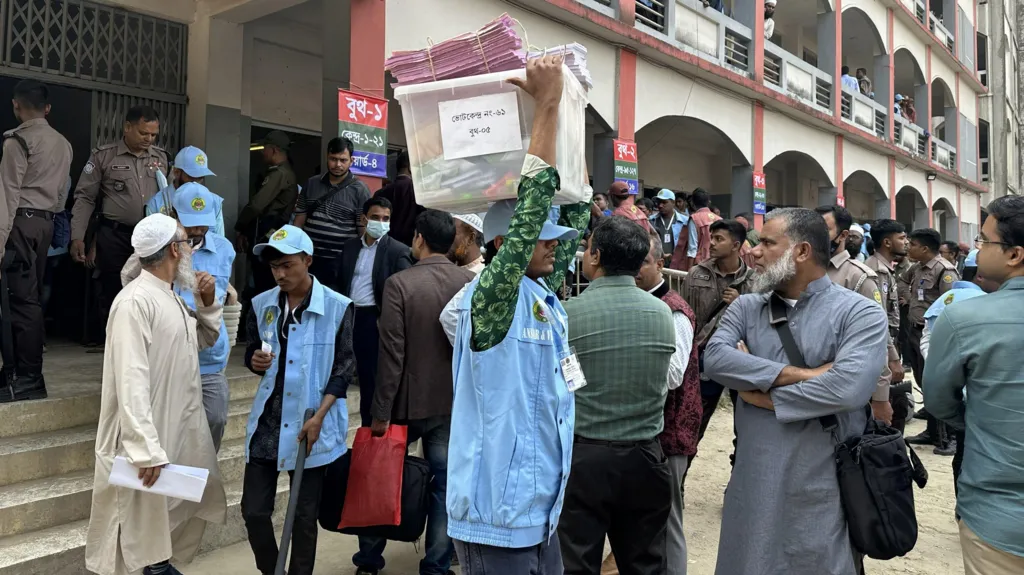
When asked if the BNP would support allowing the Awami League to re-enter the political process, senior leader Chowdhury stated that it is not up to the BNP to decide, citing the Awami League's questionable credibility.
Chowdhury noted that the Awami League's past actions, including allegations of killing and persecuting its own people, would need to be addressed before it could be considered a viable political force again.
Hasina, currently in exile in India, has denounced the recent election as a "farce" and called for a new election in which the Awami League can participate.
While public opinion is currently strongly against the Awami League, it would be premature to write off the party entirely, given Bangladesh's complex political history.
The situation remains fluid, with the new government facing significant challenges in restoring stability and democracy to the country.
Additional reporting by Aakriti Thapar
-
 News22 hours ago
Australian Politics Faces Questions Over Gender Equality Amid Sussan Ley’s Appointment
-
 News19 hours ago
Farage Says Reform to Replace Traditional Tory Party
-
 News19 hours ago
Wrexham Pair Seek Win Against Former Team Ipswich
-
 News1 day ago
Liberal Party Removes Australia’s First Female Leader
-
 News23 hours ago
UK Braces for Cold Snap with Snow and Ice Alerts Expected
-
 News19 hours ago
Husband’s alleged £600k theft for sex and antiques blamed on drug side effects
-
 News3 days ago
Sunbed ads spreading harmful misinformation to young people
-
 Business1 day ago
BBC Reporter Exposed to Cyber Attack Due to Vulnerabilities in AI Coding Tool