
News
Figure Skating Judges Explore AI Technology to Enhance Scoring Accuracy
The Milan-Cortina 2026 event has been at the center of a high-profile controversy surrounding figure skating judging in recent years, but it is not the only instance of such controversy.
At the Milan-Cortina 2026 Winter Olympics, Madison Chock and Evan Bates secured medals in both the team event and ice dance competition.
Figure skating enthusiasts may have been unfamiliar with Jezabel Dabouis just a week ago, but she has since found herself in the spotlight for reasons unrelated to her own athletic achievements.
Dabouis was among the nine judges who scored the free dance segment of the ice dance event, where the medal winners were determined after a dramatic conclusion to the competition.
On Wednesday, the French pair of Laurence Fournier Beaudry and Guillaume Cizeron narrowly edged out the American duo of Madison Chock and Evan Bates, with the two teams engaging in a fierce on-ice battle.
However, off the ice in Milan, a different story unfolded, one in which Dabouis, a French judge, played a significant role.
In the free dance, Dabouis awarded Fournier Beaudry and Cizeron a score nearly eight points higher than that of Chock and Bates, the three-time world champions and gold medalists in the team event.
While seven of the nine judges gave Chock and Bates scores exceeding 132, Dabouis assigned them a score of 129.74, the lowest among all judges.
In contrast, Dabouis awarded Fournier Beaudry and Cizeron a score of 137.45, which was their second-highest score among the judges.
Due to the scoring system in figure skating, Dabouis's score for Chock and Bates was discounted, as the highest and lowest scores are typically discarded, but her score for Fournier Beaudry and Cizeron was counted, contributing to their gold medal win.
By Saturday morning, nearly 18,500 people had signed a Change.org petition calling on the International Skating Union (ISU) and the International Olympic Committee (IOC) to investigate the judging decisions.
Silver medalist Chock has also publicly expressed her doubts about the scoring.
In a post-competition interview with BBC Sport on Wednesday night, Chock stated, "We skated to the best of our abilities, and all four of our performances, including the team event, were flawless in our opinion. We're satisfied with our skating, and the rest is beyond our control."
However, by Friday, Chock had further comments to share.
"When the public is confused by the results, it undermines our sport," the 33-year-old athlete said. "I believe it's challenging to retain fans when the scoring is difficult to understand."
"Fans need to be able to comprehend what they're cheering for and have confidence in the sport they're supporting," Chock added.
The ISU has defended its judges, including Dabouis, in response to Chock's criticism.
The ISU stated, "It's normal for judges to have varying scores, and we have mechanisms in place to minimize these discrepancies. We have full confidence in the scores and are committed to fairness."
A day-by-day guide to the Winter Olympics is available for those looking to stay up-to-date on the events.
The full schedule, including medal event times, can be found for planning purposes.
The Winter Olympics 2026 medal table is also available for tracking the progress of the games.
Laurence Fournier Beaudry and Guillaume Cizeron began competing together in November 2025, marking a new partnership for the duo.
Although this controversy surrounding figure skating judging is the most high-profile in recent years, it is not an isolated incident.
After the Olympic final, Canadian pair Piper Gilles and Paul Poirier expressed their delight at winning the bronze medal, capping off a competitive field.
In contrast, two months prior at the ISU Grand Prix Final in Nagoya, Gilles and Poirier dropped from third to fourth place, narrowly missing out on a higher finish by 0.06 points behind Lilah Fear and Lewis Gibson of Great Britain.
At the time, Gilles commented, "It's disheartening, and we can't help but feel that way. We skated two successful programs and felt strong, but the results left us questioning our efforts."
Gilles later posted a quote on social media stating, "Athletics has its own set of truths, which can be diminished and manipulated by individuals with agendas," and tagged the ISU in the post.
After winning the bronze medal in Milan, Gilles told BBC Sport, "Our focus was on creating a special moment for ourselves and letting the judging unfold as it may."
Notably, all three medal-winning couples in Milan have criticized the ISU and judges in recent months.
In November, Cizeron expressed dissatisfaction with the rhythm dance score he and his partner received at a Grand Prix event in Finland.
"I've noticed some unusual judging patterns that are damaging the sport of ice dance," Cizeron said. "I've never experienced anything like this in my career, from a judging perspective."
As with any sport that relies on judges' decisions, there will inevitably be differences in opinion.
The issue arises when these differences in opinion come from experts, including those who have won major competitions.
In Milan, Lilah Fear and Lewis Gibson set a season-best score for their Spice Girls-themed rhythm dance in the team event and appeared to have improved in the individual competition.
According to 1980 Olympic gold medalist and BBC pundit Robin Cousins, "They were better here than in the team event" after their performance.
However, the British duo was scored lower than they had been in the team event, leaving them in fourth place after the rhythm dance and ultimately seventh overall after a mistake by Fear.
Questions have also been raised in the team event and men's competition, where Ilia Malinin's showy but sometimes error-prone performances consistently score higher than those of his Japanese rival Yuma Kagiyama, largely due to the high technical marks he receives for his attempted tricks.
Live streams, highlights, and updates are available on BBC iPlayer, BBC Radio 5 Live, and the BBC Sport website and app.
Lilah Fear and Lewis Gibson represented Team GB in the ice dance event at Milan-Cortina 2026.
The ISU is aware that its sport is not perfect and that judges can face intense criticism, which is shaping the future of the sport.
Changes to the judging system will be implemented starting in July for the 2026-27 season, making the current Olympics the last to use the existing system.
The International Skating Union's 'ISU Vision 2030' initiative includes a major overhaul of the judging system, aiming to increase transparency and reduce controversy.
As part of this reform effort, figure skating is exploring the use of artificial intelligence.
Over the past two years, the ISU has been testing a system that utilizes six high-resolution cameras to track skaters' movements and analyze technical elements, such as jump rotation and spin positions, in real-time using AI.
According to ISU director general Colin Smith, the initial goal is to use the data collected to support judges, with the potential to integrate it into the scoring system in the future, starting with singles competitions before expanding to ice dance.
Smith explained that this system would allow judges to focus on the artistic aspects of a performance, while the computer vision technology handles the technical aspects, providing a more objective assessment.
However, it remains to be seen whether this technology will completely eliminate controversy in the sport.
Notable figures in the ice dance community, including France's Olympic champions, have been at the center of judging controversies in the past.
Other notable moments, such as Malinin's and Minion's performances, as well as Milan's emotional highlights, have also garnered attention.
Shaidorov's gold medal win, coupled with Malinin's disappointing performance, has been a significant talking point.
Canada's Piper Gilles, an ice dance competitor, has been an outspoken critic of the ISU's judging practices.
To understand the complexities of figure skating judging, it is essential to examine the current scoring system.
The existing method was introduced after the 2002 Salt Lake City Olympics, where a judging scandal led to Canadian figure skaters Jamie Sale and David Pelletier being initially denied victory, only to be later awarded joint gold.
At the Milan-Cortina 2026 Olympics, technical specialists will identify and evaluate the elements performed by skaters in real-time, in addition to assessing their difficulty.
A panel of nine judges will evaluate the quality of each element, with the judges selected from a pool of 13 for the Olympics.
Each element is assigned a base value, and judges will award a grade of execution score, ranging from -5 to +5, to each performed element.
The highest and lowest scores are discarded, and the average of the remaining seven scores determines the grade of execution for that element, with the technical score calculated by summing the scores of all elements.
Additionally, judges will assess the program components, awarding points on a scale from 0.25 to 10 to evaluate the overall presentation.
The final score is determined by adding the technical score and program component scores, then subtracting deductions for errors such as falls.
The combined scores of the two categories yield the final score, with the competitor or couple achieving the highest total score declared the winner.





News
Banton hits three sixes off Watt
During the T20 World Cup, England’s Tom Banton hit Scotland’s Mark Watt for three sixes in a single over.
In a notable display of batting prowess, Tom Banton of England hit three sixes in a single over against Scotland's Mark Watt during the T20 World Cup.
Live updates are available for the England-Scotland match.
Access to this content is restricted to users within the United Kingdom.
News
Australian Anthony Claims Gold in Moguls After Rivals Exit in Chaotic Event
At the Olympics, Jakara Anthony of Australia made history by claiming the inaugural women’s dual moguls title, outperforming Americans Jaelin Kauf and Elizabeth Lemley, who secured the silver and bronze medals, respectively.
Jakara Anthony of Australia has made history by becoming the inaugural women's dual moguls Olympic champion, surpassing American athletes Jaelin Kauf and Elizabeth Lemley, who secured the silver and bronze medals, respectively.
For more Winter Olympics coverage, additional videos are available to stream.
Access to this content is restricted to users within the United Kingdom.
News
Morrison Shines with Top Performances in Match Against Canada
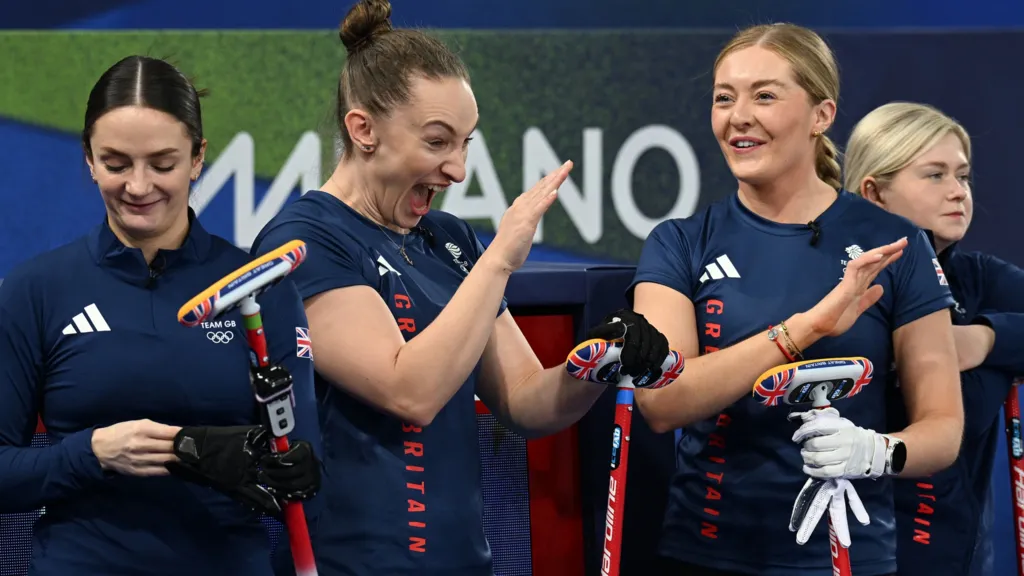
Highlights of Rebecca Morrison’s performance can be seen as Great Britain secured a 7-6 win against Canada, the reigning world champions, in the women’s curling event at the 2026 Winter Olympics.
Highlights from Rebecca Morrison's performance are now available, showcasing Great Britain's narrow 7-6 win over reigning world champions Canada in the women's curling event at the 2026 Winter Olympics.
Further coverage of the surprising outcome can be found in the article detailing Great Britain's women's curling team upsetting world champions Canada.
Access to this content is restricted to users within the United Kingdom.
-
 News1 day ago
Australian Politics Faces Questions Over Gender Equality Amid Sussan Ley’s Appointment
-
 News1 day ago
Farage Says Reform to Replace Traditional Tory Party
-
 News1 day ago
Husband’s alleged £600k theft for sex and antiques blamed on drug side effects
-
 News1 day ago
Wrexham Pair Seek Win Against Former Team Ipswich
-
 Business2 days ago
BBC Reporter Exposed to Cyber Attack Due to Vulnerabilities in AI Coding Tool
-
 News2 days ago
Liberal Party Removes Australia’s First Female Leader
-
 News1 day ago
UK Braces for Cold Snap with Snow and Ice Alerts Expected
-
 News3 days ago
Sunbed ads spreading harmful misinformation to young people