
News
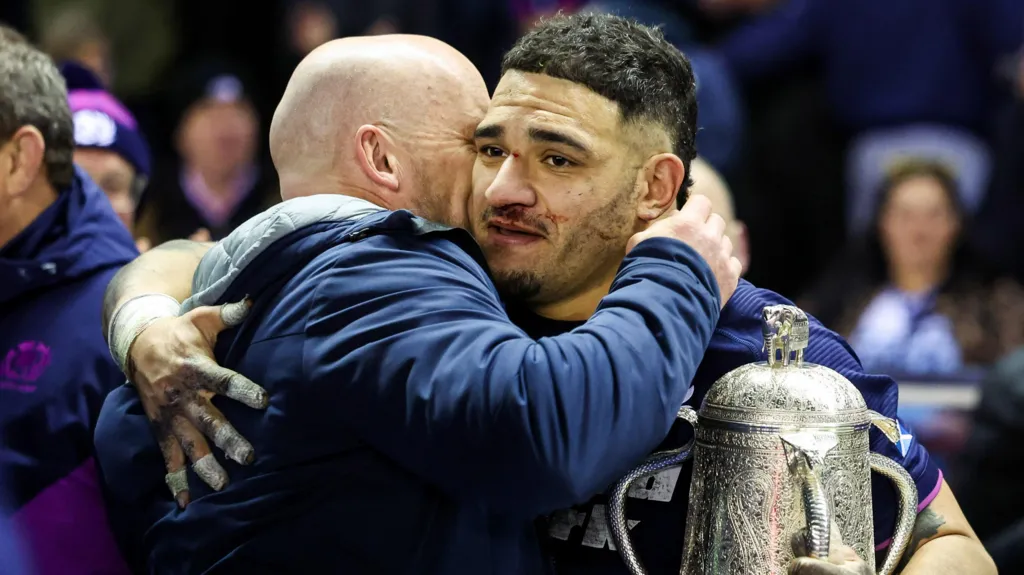
Scotland Secure Convincing Calcutta Cup Victory Over England
Scotland rebounded from their Six Nations loss to Italy the previous week, earning a bonus-point victory over England in a thrilling Calcutta Cup match at Murrayfield.
The scoring breakdown was as follows: Jones scored two tries, while Ritchie and White each added one. Russell successfully converted four and also kicked a penalty.
England's points came from tries by Arundell and Earl, with Ford converting one and kicking two penalties.
Following their Six Nations loss to Italy the previous week, Scotland rebounded with a bonus-point victory over England in the Calcutta Cup at Murrayfield, in a match that was both intense and thrilling.
Led by the exceptional Finn Russell, Scotland played with a relentless intensity that left England struggling to cope.
Despite facing criticism prior to the match, Gregor Townsend's team made a strong start, taking a 17-0 lead within the first quarter of an hour.
Russell kicked a penalty, and Jones, Ritchie, and White scored tries, while England's response consisted of a converted try by Arundell and a penalty by Ford.
Arundell's match was marked by two yellow cards in the first half, resulting in England playing with 14 men for 30 minutes, during which time Scotland scored 14 points.
At halftime, Scotland held a 24-10 lead, which Ford narrowed early in the second half with a penalty, before Jones scored his second try after a charged-down Ford drop goal attempt.
Unlike in previous matches, Scotland maintained their intensity and did not let their lead slip, as they effectively countered England's pressure with strong defense and counterattacks.
Although Earls scored a late try to reduce the deficit, it had little impact on the outcome, as Murrayfield celebrated a convincing Scottish victory.
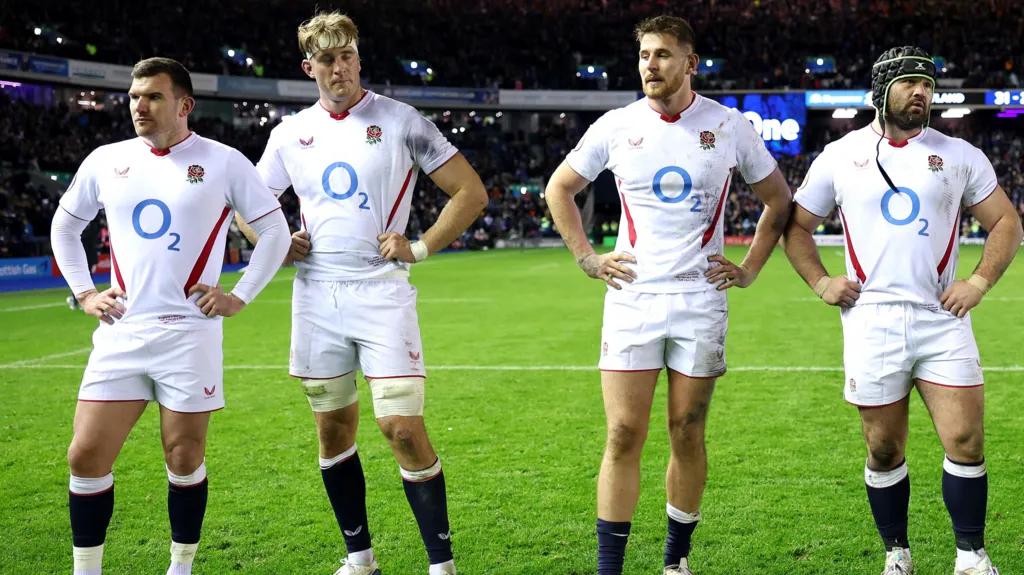
The loss marked a significant setback for England, who had been seeking their 13th consecutive win and first victory in Edinburgh since 2020.
Finn Russell played a crucial role in Scotland's win, demonstrating his skill and vision throughout the match.
After a disappointing performance in Rome, Scotland delivered a strong reaction, showcasing their intensity, accuracy, and ruthlessness from the outset.
The match began with Russell kicking an early penalty, which set the tone for Scotland's dominant start, as they played direct and physical rugby that England struggled to match.
Arundell's first yellow card, received within 10 minutes, proved costly for England, as Scotland capitalized on the numerical advantage, with Russell orchestrating the attacks.
Russell's clever playmaking created a try-scoring opportunity, which Jones exploited by sprinting past Maro Itoje after receiving a one-handed pass from Russell.
The Scottish fly-half extended the lead to 10-0, and his team continued to build momentum, addressing the lack of ruthlessness that had hindered them in Rome.
In their next attack, Scotland demonstrated their speed and skill, as Sione Tuipulotu's long pass found Ritchie on the left wing, and the blindside scored with ease.
Russell's conversion made it 17-0, and England, who had been heavy favorites, found themselves reeling from the intense Scottish start.
England eventually gained some traction, with their dominant scrum and powerful runners allowing them to penetrate Scotland's 22, and Arundell scored a try after a delayed pass from Ford.
Ford reduced the deficit to seven points with a penalty, but Scotland quickly responded with their third try, sparked by Russell's inventive play.
The Scottish fly-half's ingenuity created an opportunity, as he evaded several defenders and kicked the ball while falling, and Ellis Genge's error allowed White to score a try.
Russell's conversion extended the lead to 14 points, and Arundell's second yellow card, received just before halftime, further compounded England's difficulties.
The wing's indiscretion, which resulted in a 20-minute red card, left England facing an uphill task in the second half.
England's scrum superiority allowed them to narrow the gap early in the second half, with Ford kicking a penalty, but Scotland's defense held firm.
As England applied pressure, Scotland's defense remained solid, and Ford opted to take a drop goal, which backfired when Fagerson charged down the kick.
The loose ball was scooped up by Fagerson, who fed Jones, and the Scottish center scored his second try, securing a bonus point for his team.
Russell's conversion extended the lead to 18 points, and England's attempts to reduce the deficit were ultimately unsuccessful.
Although England emptied their bench and introduced several heavy hitters, they could only manage a late try by Earl, converted by Ford, which reduced the deficit to 11 points.
The final score reflected Scotland's dominant performance, as they secured a well-deserved victory, with the home fans celebrating a memorable win.
The Scotland team consisted of: Jordan, Steyn, Jones, Tuipulotu, Dobie, Russell, White; McBeth, Turner, Z Fagerson, Brown, Cummings, Ritchie, Darge, Dempsey.
The replacements were: Cherry, Schoeman, Millar-Mills, Williamson, M Fagerson, Horne, Hastings, Graham.
The England team was: Steward; Roebuck, Freeman, Dingwall, Arundell; Ford, Mitchell; Genge, Cowan-Dickie, Heyes, Chessum, Itoje, Pepper, Underhill, Earl.
The England replacements were: George, Rodd, Davison, Coles, Pollock, T Curry, Spencer, F Smith.
The match was refereed by Nika Amashukeli from Georgia.


News
Tuipulotu Credits Scotland for Delivering Under Townsend
Captain Sione Tuipulotu credited the team’s Calcutta Cup victory to a strong performance by Scotland, which in turn alleviated some of the pressure on head coach Gregor Townsend.
Captain Sione Tuipulotu has praised Scotland's impressive Calcutta Cup win, which came after a difficult week for head coach Gregor Townsend, with the team delivering a much-needed triumph.
Following their opening Six Nations defeat to Italy in Rome, Scotland's championship aspirations were under scrutiny as they hosted an in-form England side at Murrayfield, with Townsend's position under increased pressure.
The hosts made a stunning start, racing into a 17-0 lead within 15 minutes, a cushion they maintained for the remainder of the match.
Scotland's performance was characterized by pace and flair, with fly-half Finn Russell playing a pivotal role in the victory.
Russell's vision and distribution were instrumental in creating tries for Huw Jones and Jamie Ritchie, as Scotland's attacking play flourished.
Despite England's response, which included a try from Henry Arundell before his dismissal for a second yellow card, Scotland continued to play with freedom, adding a third try after Ellis Genge failed to gather Russell's chip, allowing Ben White to capitalize.
England, who had won their previous 12 Tests, attempted a comeback in the second half, but Scotland's defense held firm, and they sealed a bonus-point victory with Jones' second try, following a charged-down drop-goal attempt by George Ford.
Tuipulotu expressed his pride in the team's performance, saying he was "extremely proud" of the way they responded to their defeat in Italy.
The Scotland captain acknowledged that the team had deserved criticism after their loss to Italy, but felt they had redeemed themselves with a strong display against England.
Tuipulotu stated that the team had felt under pressure, but had rallied behind their coach, delivering a performance that justified their support.
The captain admitted to feeling a sense of guilt, recognizing the challenges faced by head coaches, who receive criticism when the team performs poorly.
Tuipulotu praised his teammates for their commitment to the coach and their role in the victory, saying they had "got behind our coach and delivered a performance."
The Scotland Rugby Podcast has reaction from a jubilant Murrayfield, with players and coaches reflecting on the impressive win.
Scotland will now travel to Spain to recover before their next championship match against Wales, looking to build on their momentum.
Tuipulotu emphasized the importance of maintaining their performance level, saying the team would do everything possible to replicate their victory against Wales.
The Glasgow Warriors centre said he wanted to enjoy the win, but was already focused on preparing for the next match, ensuring they "prepare to the best of our abilities to back up this performance."
Former Scotland captain John Barclay echoed Tuipulotu's sentiments, stressing the need for consistency and saying that the best teams are able to maintain their performance levels.
Barclay, speaking on ITV, said that Scotland must "back it up" and avoid a significant drop-off in performance if they are to progress as a team.
The former skipper emphasized that the team's focus should be on replicating their Calcutta Cup win, with Tuipulotu and Townsend already highlighting the importance of consistency.
Barclay noted that the top teams are able to maintain their performance levels, with minimal drop-off, and that Scotland must strive to achieve this if they are to succeed.
Scotland's convincing win over England has rejuvenated their championship campaign, with the team sweeping aside their opponents in a stunning Calcutta Cup victory.
Townsend has expressed his pride in the team's performance, which saw them dominate England and regain the Calcutta Cup.
The match highlights are available, showcasing Scotland's impressive display.
Townsend has spoken about Scotland's emphatic victory, praising the team's performance and highlighting the challenges they faced.
The Scotland head coach has faced a difficult period, with three defeats in four Tests and speculation about his future, but the win over England has eased the pressure.
Townsend's position had been under scrutiny, with some questioning whether he had taken the team as far as he could, but the Calcutta Cup win has provided a timely boost.
The head coach praised the team's first-half display, saying it was some of the best rugby he had seen from a Scotland team.
Townsend told ITV that the team's performance in the opening 20 minutes was exceptional, and that he was proud of the way they fought for each other and the supporters in the second half.
The head coach attributed the team's success to their aggressive and fast-paced play, saying that Finn Russell had one of his best games for Scotland and the forwards' work-rate was superb.
Scotland have now won five of the last six Calcutta Cup matches, with Russell's missed conversion last year denying them a sixth consecutive win.
Former Scotland prop Peter Wright praised the team's performance, saying they had made England look "pretty mediocre."
Wright noted that Scotland's inconsistency is frustrating, as they can produce performances like the Calcutta Cup win, but also struggle, as they did against Italy.
The former prop said that the players deserved credit for their display, which was a significant improvement on their previous outing.
Scotland's players have been praised for their commitment to the coach and their role in the victory.
The match highlights are available, showcasing Scotland's impressive display.
England head coach Steve Borthwick said that Scotland's players had "shown up" for their coach, delivering a performance that justified their support.
Townsend dismissed the idea that Scotland only produce their best performances against England, saying that the team sees it as a positive that they can raise their game for the Calcutta Cup match.
The head coach said that the team had played some of their best rugby against England, and that this was a testament to the players' ability to perform under pressure.
Townsend emphasized that the team's focus is on the positives, rather than the negatives, and that they are proud of their record in the Calcutta Cup fixture.
The head coach reflected on the team's performance against Italy, saying that they had shown resilience and determination, even in defeat, and that he was proud of the players' efforts in difficult conditions.
The players' dedication and hard work throughout the week are evident, and their performance on the weekend is a testament to their commitment. Regardless of the outcome, it is clear that their energy and effort are not the issue. The team's efforts have been commendable, and their coach's pride in them has been consistent, whether in victory or not, as seen in the past two weeks.
News
Kane Reaches Milestone 500th Career Goal as First English Player
Harry Kane, the striker for Bayern Munich, made history by scoring his 500th professional goal in an official match, achieving this milestone with a long-range shot against Werder Bremen, thereby becoming the first English player to reach this mark.
In a notable achievement, Harry Kane, the striker for Bayern Munich, has successfully scored his 500th professional goal in an official match, making him the first English footballer to reach this milestone after scoring from distance against Werder Bremen.
For more information on Harry Kane's record-breaking feat and other potential records he may break, additional details are available.
Access to this content is restricted to users based in the United Kingdom.
News
England Suffer Defeat in Historic Test Match at Murrayfield
England captain Maro Itoje has urged his team to take a constructive approach to their recent performance, acknowledging that a series of mistakes ultimately derailed their efforts to recover from a sluggish beginning against Scotland.
Following a 12-match winning streak, England captain Maro Itoje acknowledged that his team would need to learn from their recent defeat.
A specific moment can be identified when Scotland halted England's unbeaten run.
At the 56-minute mark, the Murrayfield crowd was in the midst of singing "Flower of Scotland" after Huw Jones' second try, when Rory Darge secured a crucial turnover within his own 22-meter line.
Although the crowd's enthusiasm continued uninterrupted, it marked a significant turning point, as Scotland had already gained the upper hand.
England's winning streak came to an end at 12 matches, and it was not solely due to bad luck.
By halftime, England faced a significant deficit, regardless of how it was measured.
The scoreboard showed a 14-point gap, and England were also at a disadvantage in terms of personnel and crowd support at Murrayfield.
However, at that point, the situation did not seem insurmountable for England.
Scotland achieved a convincing Calcutta Cup victory, overwhelming England in the process.
Scotland's head coach, Townsend, expressed pride in his team's performance, which saw them reclaim the Calcutta Cup from England.
Finn Russell played a key role in Scotland's success, showcasing his agility, ball-handling skills, and game intelligence, particularly in the opening stages when he set up a try for Huw Jones.
Scotland's team, which had struggled against Italy the previous week, demonstrated a ruthless approach, scoring 24 points from four visits to England's 22-meter line in the first 40 minutes.
England, however, had also contributed to their own difficulties.
Henry Arundell was a notable factor, receiving two yellow cards, first for failing to release the tackled player and then for a clumsy challenge on Kyle Steyn while he was in the air.
Arundell's absence, which totaled 30 minutes, allowed Scotland to exploit the space and gain an advantage.
Arundell received his second yellow card after failing to quickly release from an aerial contest with Kyle Steyn.
Arundell was not the only England player to make individual errors.
Luke Cowan-Dickie's tackle without using his arms provided Scotland with the field position that led to Jamie Ritchie's try.
Ellis Genge, who was tasked with a role that did not suit him, made a mistake by failing to secure a loose ball, resulting in a try for Scotland.
Collectively, England's defense, which had been solid in the past year, showed signs of vulnerability that Scotland were able to capitalize on.
Despite these challenges, the game was not yet lost for England.
If England could eliminate individual errors, improve their defense, and capitalize on their strengths in the scrum, there was a potential path back into the game.
Successfully executing this plan would be a significant validation of England's progress as a team.
Scotland had previously shown vulnerabilities, such as when they squandered a 21-point lead against Argentina, and England's bench could potentially make a difference.
The theoretical possibility of a comeback existed.
For a brief period, it seemed that England might be able to turn the game around.
(No changes, as this paragraph appears to be a video notice)
According to Borthwick, Scotland's players had risen to the occasion and performed well for their coach, Townsend.
Ellis Genge won a penalty from Zander Fagerson two minutes into the second half, and George Ford successfully kicked it to reduce the deficit to 24-13.
The Scotland front row was again penalized, and Murrayfield's atmosphere became slightly more tense.
As George Ford lined up a drop-goal attempt on 53 minutes, it seemed that England might start to exert pressure on the scoreboard.
However, Ford did not provide himself with sufficient space, and Matt Fagerson, who had just come off the bench, was able to charge down the kick.
The resulting try sealed England's fate, and Scotland's fans celebrated in the stands.
England's replacements were introduced, but they were unable to make a significant impact, and Scotland comfortably closed out the game.
Borthwick noted that the charged-down drop-goal attempt by Ford was a crucial moment in the game but not the sole reason for England's defeat.
Borthwick described his team as one that had consistently been able to reel in opponents over a long period.
He pointed out that if Ford's drop-goal attempt had been successful, the score would have been 24-16 with 24 minutes remaining, which would have given England a different outlook.
Borthwick emphasized that the 10-point swing resulting from the charged-down drop-goal was significant but not the only factor that contributed to the result.
Matt Fagerson's charge-down of Ford's drop-goal attempt led to a try for Huw Jones and effectively sealed the game.
Prior to the tournament, Richard Wigglesworth, Borthwick's assistant, had suggested that England's criticism in 2024 and praise in 2025 might have been exaggerated, implying that the team's performances were not as extreme as perceived.
In hindsight, these words have proven to be prophetic.
Captain Maro Itoje emphasized the importance of learning from mistakes, stating, "We have to learn our lesson and move forward."
Itoje acknowledged areas for improvement, noting, "Our start was subpar, and we lacked accuracy and precision, particularly in the scrum – these are aspects that require significant enhancement."
Reflecting on the team's performance over the past year, Itoje observed, "While we've been adept at adapting to challenges and finding solutions over the last 12 months, we fell short in that regard today."
The team must absorb these lessons quickly, as a loss to Ireland next weekend would likely derail their Six Nations title aspirations.
England's schedule includes upcoming away matches against Italy, France, and reigning world champions South Africa.
If England fails to regain their footing, they can expect to face intense pressure in the coming weeks.
Listen to the podcast: Sport's Strangest Crimes – the Bloodgate scandal.
The latest episode of the Rugby Union Weekly podcast is now available for listening.
-
 News2 days ago
Australian Politics Faces Questions Over Gender Equality Amid Sussan Ley’s Appointment
-
 News2 days ago
Farage Says Reform to Replace Traditional Tory Party
-
 News2 days ago
Husband’s alleged £600k theft for sex and antiques blamed on drug side effects
-
 Business2 days ago
BBC Reporter Exposed to Cyber Attack Due to Vulnerabilities in AI Coding Tool
-
 News2 days ago
Wrexham Pair Seek Win Against Former Team Ipswich
-
 News2 days ago
Liberal Party Removes Australia’s First Female Leader
-
 News2 days ago
UK Braces for Cold Snap with Snow and Ice Alerts Expected
-
 Health2 days ago
NHS Waiting List Hits Three-Year Low