
News
Team GB takes the lead in curling technology advancements
The National Curling Academy, situated in Stirling, welcomes a diverse range of individuals, from novice sweepers to elite Olympic athletes, offering a premier training environment.
Team GB is at the forefront of curling's technological advancements, with a state-of-the-art facility that is redefining the sport.
Upon entering the National Curling Academy in Stirling, one is immediately struck by the plethora of cameras capturing every angle of the ice sheets, from fixed positions to those suspended from cables or maneuvered by long arms.
The academy's coaches, dressed in anoraks and equipped with laptops, engage in in-depth discussions of data displayed on large screens, punctuated by the sound of granite stones colliding, as Team GB's curlers refine their skills on the meticulously prepared ice.
Located on the outskirts of Stirling, the National Curling Academy is situated within a public leisure center, where locals participate in aerobics classes and swimming lessons, unaware of the cutting-edge curling facility nearby.
However, upon passing through a side door, visitors are transported to a world where British Curling is pushing the boundaries of innovation and excellence.
According to Nikki Gibson, head of performance services at British Curling, "We strive to stay ahead of the curve in terms of nutrition, physical performance, conditioning, innovation, and technology, but the competition is intensifying."
Day-by-day guide to the Winter Olympics
Full schedule including times of medal events
Winter Olympics 2026 medal table
It has been 24 years since Rhona Martin's historic Stone of Destiny in Salt Lake City, which captivated millions of viewers in the UK and marked Britain's first Winter Olympics gold in 18 years.
The perception of curling as an unusual sport, played by Scottish housewives with "daft wee brooms," was misguided even back then, and is now even further from reality.
The current Team GB curlers, representing the country in Cortina, are a far cry from this outdated stereotype, with their rigorous training regimens and scientific approach to the sport.
These athletes engage in strength training akin to sprinters, strategic planning like chess players, and nutritional practices similar to those of Tour de France cyclists.
A typical weekday for Team GB curlers begins with training at 08:30, consisting of two two-hour ice sessions and one gym session, with a focus on strength and conditioning.
Over the course of a week, the athletes participate in three strength-based gym sessions and two conditioning sessions, with many adding an extra session on the weekends to maintain their physical fitness.
These gym sessions are carefully supervised and tailored to the specific demands of curling, with a focus on Olympic lifts, such as clean and jerk, snatches, and squats.
As Hammy McMillan, a gold medal contender, explains, "We're using a range of equipment, including ski machines, rowers, and assault bikes, to condition our bodies and prepare for the physical demands of curling."
Bobby Lammie, credited with revolutionizing the physicality expected of sweepers, notes that the numbers they achieve in the gym are often surprising, even to outsiders.
This attention to physical detail has allowed Team GB to distinguish themselves from their competitors and gain a competitive edge.
A similar trend is evident in the women's game, where 2022 gold medallist Jen Dodds is lifting impressive weights, often surpassing those of her male counterparts.
According to Team GB women's skip Rebecca Morrison, "Jen is incredibly strong in the gym, and it's essential for maintaining the core strength needed to stay upright on the ice."
Morrison emphasizes that curling requires a unique combination of physical strength, balance, and strategy, making it a more demanding sport than many people realize.
The physical demands of curling are often underestimated, but the reality is that it requires a great deal of core strength, balance, and agility to navigate the ice and maintain control.
This video can not be played
Science of the Winter Olympics – Curling
The grueling schedule of curling competitions, which can involve playing for 17 consecutive days, highlights the importance of a rigorous fitness regime.
The demands of traveling to competitions, often to distant locations such as Canada or Asia, further emphasize the need for curlers to be in top physical condition.
To perform at their best, curlers must be fit and properly fueled, making nutrition a critical aspect of their training.
British Curling employs a nutritionist who has successfully implemented a nutrition plan that approaches food in a similar way to that of a Tour de France team.
While the specific dietary needs of curlers may differ from those of cyclists, the underlying principles of proper nutrition remain the same.
As Nikki Gibson explains, "Our goal is not to dictate what athletes can or can't eat, but to create a culture where they make informed choices that support their performance."
The nutritionist works with athletes to make small, targeted changes to their diets, such as incorporating berries into their evening routine to improve sleep quality.
This approach recognizes that athletes are not expected to be perfect in their dietary choices, but rather to make conscious decisions that support their overall performance.
British Curling also provides travel packs for curlers, which include high-protein snacks, hand sanitizers, and other essentials to help them stay healthy and perform at their best while on the road.
These packs are designed to support the athletes' overall well-being, both physically and mentally, and are a key component of the "what it takes to win" model.
This model encompasses a range of areas, including performance lifestyle advisors, who provide guidance on financial planning and work-life balance, as well as psychology and nutrition.
This video can not be played
'Chess on ice' – Team GB break-down the rules of curling
The "what it takes to win" model is a comprehensive approach that addresses every aspect of an athlete's life, from training and nutrition to mental preparation and lifestyle.
By embracing this holistic approach, British Curling aims to provide its athletes with the tools and support they need to succeed at the highest level and dominate the sport of curling.
The scope of their work encompasses various aspects, including on-ice strategies, such as pre-shot routines and performing under pressure, as well as team dynamics and communication.
However, each individual is unique, making it a challenge for Gibson and her team to tailor their approach. For instance, men's alternate Kyle Waddell prefers a relaxed approach, whereas others require customized energy plans to manage their mental state before matches.
According to Gibson, a one-size-fits-all approach is not effective, as she notes, "Every athlete has different needs, and it's essential to avoid overwhelming them with too much information, as this can be counterproductive."
Gibson's primary objective is to minimize stress and distractions, allowing athletes to focus solely on competition.
This video is currently unavailable for playback.
The origin of all Olympic curling stones is a small, uninhabited Scottish island, a fascinating fact about the sport.
Looking ahead to the next Olympic cycle, Gibson identifies two key areas that may undergo significant changes: physicality and artificial intelligence.
While it's unlikely that current curlers will appear out of shape by the 2034 Games, Gibson anticipates that sweepers will become more physically imposing, enabling them to exert greater pressure on the brush.
She predicts that their training regimen will resemble that of 400m sprinters, with a strong emphasis on building strength and endurance.
The most substantial advancements, however, may arise from the integration of artificial intelligence.
British Curling already collects extensive data on training sessions and competitions, but the key will be to leverage this data to develop more effective match strategies, potentially through simulations of various scenarios.
As Gibson explains, "The margin for error is extremely small, with athletes expected to make 96% of their shots; one mistake can be the difference between gold and silver, making every innovation crucial."
The sport's top tier is highly competitive, and the level of dedication required may surprise many, as Gibson notes, "It's not just a matter of showing up and throwing stones; it's a demanding regimen that involves intense physical and mental preparation."
The amount of time and effort invested by these athletes is substantial, with a rigorous routine that includes countless hours of practice, strength training, nutritional planning, and mental preparation, all of which require a significant commitment from both the athletes and the support team.
News
GB men’s curling team suffers upset defeat to Italy
At the 2026 Winter Olympics, Great Britain’s men’s curling team mounted a comeback against Italy following a disappointing beginning, ultimately falling short in their inaugural match.
Despite a valiant comeback, Team GB ultimately fell short as Italy held their composure to secure the win in the final end.
A dismal start to the match proved costly for Team GB's men, as they suffered their first defeat of the Winter Olympics at the hands of host nation Italy, despite a spirited fightback in the packed Cortina Curling Stadium.
Following victories in their first two matches, including a win over the Swedish rink that beat them in the gold-medal match four years ago, Team GB entered their second high-profile encounter in as many days in a confident position.
However, a disastrous opening end, in which Italy stole four points, left Team GB trailing and facing an uphill battle in front of a boisterous home crowd.
The British team, currently ranked number one in the world, gradually regained their footing and managed to level the score by the ninth end.
Ultimately, Italy maintained their composure in the final end to emerge victorious, winning 9-7 and adding Team GB to their list of scalps, which already included the Swedes.
"We had to dig deep and play some solid curling, but unfortunately, it wasn't enough to get us over the line," Team GB lead Hammy McMillan said in an interview with BBC Sport.
With seven wins from nine round-robin matches guaranteeing a spot in the semi-finals, Team GB remains in a strong position, although fewer wins may still be sufficient to advance.
The women's team is set to take to the ice next, facing South Korea in their second match at 13:05 GMT, while the men will return to action on Saturday against the Czech Republic at the same time.
Team GB is at the forefront of curling's technological advancements.
Embracing what sets you apart can be a powerful asset, according to some athletes.
A daily guide to the Winter Olympics is available for those looking to stay up-to-date with the action.
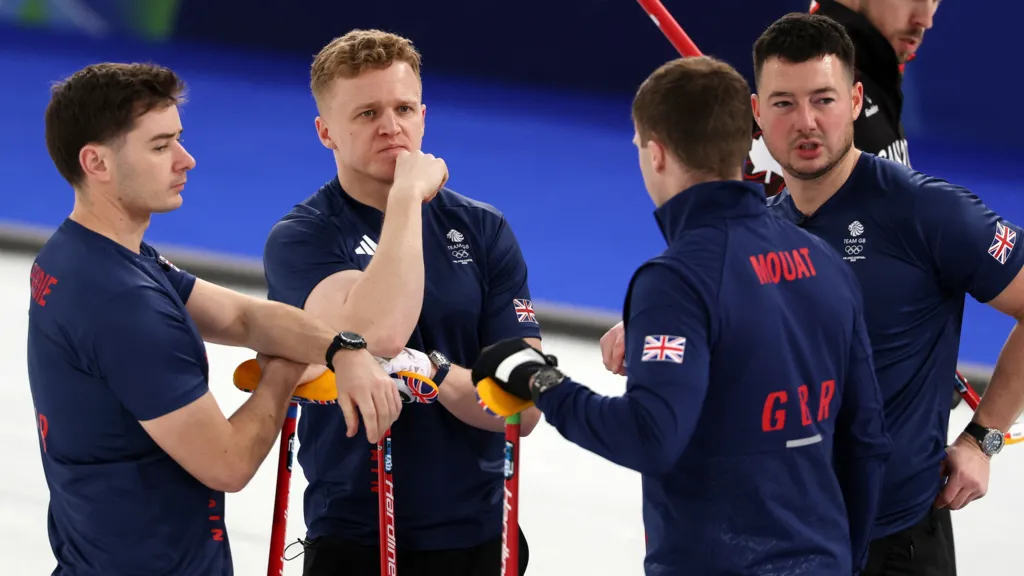
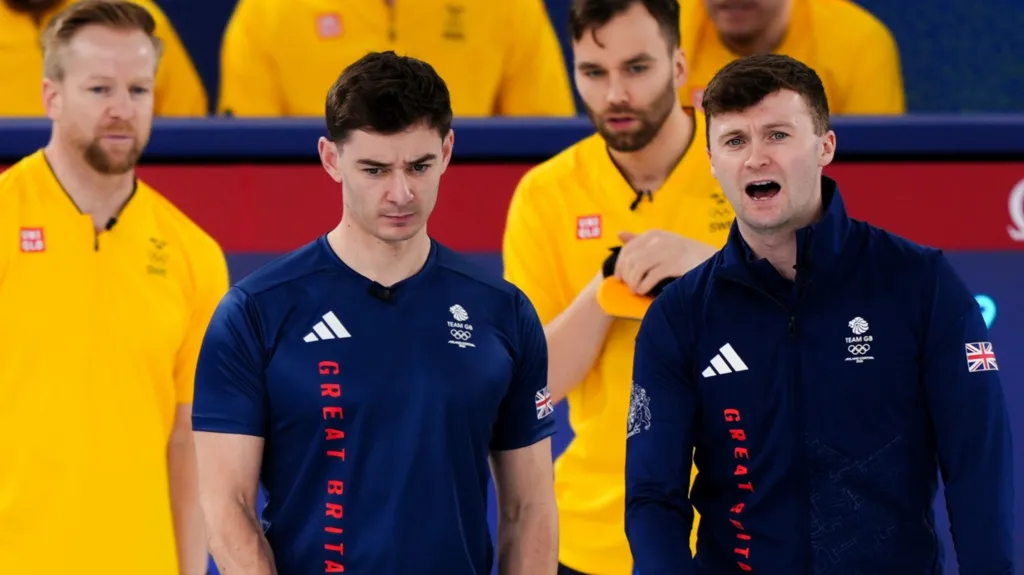
The looks of shock on the faces of Team GB's curlers told the story of a disastrous opening end.
With a stone in play, Mouat attempted a risky shot in an effort to claim two points, but it backfired, resulting in none of Team GB's stones in the house and four Italian stones in position.
However, the Scottish quartet, ranked number one in the world, quickly regained their composure and got back to their game.
The teams exchanged singles before a impressive final throw by Mouat, aided by a measurement to determine which stone was closest to the button, allowed Team GB to claim two points and narrow the gap to 5-3.
Another excellent team effort, which included a well-judged throw by Mouat, a solid sweep by Hammy McMillan and Bobby Lammie, and Grant Hardie's strategic expertise, forced Italy to concede a point in the fourth end, reducing the deficit to a single point at the break.
Italy blanked the sixth end and added two points in the seventh to rebuild their lead, but Team GB fought back with two points of their own, remarkably levelling the score with one end remaining after a steal.
The match came down to the final end, but Italy held their nerve to secure the win, prompting a deafening roar from the crowd.
"It's an incredible experience, and we need to get used to it," McMillan added, describing the electric atmosphere as "surreal" and "cool," more akin to a football match than a typical curling crowd.
News
Scotland Kicks Off Nations League Against Slovenia
Uefa has released the schedule for the Nations League, with Scotland set to begin their campaign on 26 September with an away match against Slovenia.
Uefa has released the schedule for the Nations League, with Scotland's campaign set to begin on 26 September with an away match against Slovenia.
The team's six group stage games will be played within a three-month period, culminating in a match against Switzerland on 16 November.
The fixture list was announced following Thursday's draw, which placed Scotland in a group with Switzerland, Slovenia, and North Macedonia.
Having been relegated from League A after a play-off loss to Greece last year, Scotland will compete in the second tier of the Nations League this year.
In response to the draw, head coach Steve Clarke noted that the teams in the group appear to be evenly matched.
Clarke reflected on the team's past experience in the competition, stating that it has been beneficial for Scotland.
He emphasized the importance of the Nations League, citing its role in helping the team qualify for Euro 2020, and anticipated a challenging set of matches.
A key matchup in the Nations League will see Scotland face off against Switzerland.
The group stage will determine the teams' fates, with the winner earning promotion, the runner-up entering a play-off, the third-placed team facing a relegation play-off, and the fourth-placed team being relegated directly.
The upcoming group games will mark a reunion for Scotland and Switzerland, who previously drew 1-1 in Cologne at Euro 2024.
Scotland's last encounter with Slovenia was during the 2018 World Cup qualification campaign, when they won 1-0 at home and drew 2-2 away.
The team has not played North Macedonia since the 2014 World Cup qualifiers, when they drew 1-1 at home and won 2-1 away, with goals from Ikechi Anya and Shaun Maloney.
The schedule for Scotland's Nations League campaign begins on 26 September with a match against Slovenia.
The team will then host Switzerland on 29 September, followed by a trip to face North Macedonia on 3 October.
Scotland will then play Slovenia at home on 6 October, before hosting North Macedonia on 11 November.
The final group stage match will see Scotland travel to face Switzerland on 16 November.
The team's home match against North Macedonia is set for 11 November.
The campaign will conclude with an away match against Switzerland on 16 November.
News
Golfer McIlroy Sinks Bunker Shot at Pebble Beach Pro-Am
At the AT&T Pebble Beach Pro-Am in California, Rory McIlroy achieved an eagle on the 14th hole at Spyglass Hill, capping off his opening round with a score of 68.
During the AT&T Pebble Beach Pro-Am in California, Rory McIlroy achieved an eagle on the 14th hole at Spyglass Hill, contributing to his first-round score of 68.
For further information, Rory McIlroy had a solid opening round, while Hisatsune took the lead.
Access to this content is restricted to users in the United Kingdom.
-
 News8 hours ago
Australian Politics Faces Questions Over Gender Equality Amid Sussan Ley’s Appointment
-
 News5 hours ago
Farage Says Reform to Replace Traditional Tory Party
-
 News5 hours ago
Wrexham Pair Seek Win Against Former Team Ipswich
-
 News11 hours ago
Liberal Party Removes Australia’s First Female Leader
-
 News8 hours ago
UK Braces for Cold Snap with Snow and Ice Alerts Expected
-
 News5 hours ago
Husband’s alleged £600k theft for sex and antiques blamed on drug side effects
-
 Business11 hours ago
BBC Reporter Exposed to Cyber Attack Due to Vulnerabilities in AI Coding Tool
-
 News8 hours ago
Canadian Town Unites in Mourning After Mass Shooting Leaves Community Reeling