
News
Technology’s Impact on Traditional Baking and Food Production
The incorporation of robotic technology and automated systems in the food sector poses additional challenges.
The Thomas Tunnock factory, located just outside Glasgow, features a continuous flow of hot caramel that plays a crucial role in the production process.
This caramel, made on the second floor, travels down to the first floor via conveyor belts, filling the building with a warm, sweet aroma that is unmistakable.
However, working with caramel is a complex task that requires precision and teamwork; a team of 12 experienced workers must ensure the caramel reaches the correct consistency before applying it in five layers to create the signature Tunnock's wafer biscuit.
According to Stuart Louden, the company's engineering and transport manager and a fifth-generation member of the Tunnock family, the factory produces approximately 20 tonnes of caramel daily.
To achieve the perfect consistency, operators rely on a combination of visual inspection and tactile testing, often squeezing the caramel to assess its texture and quality.
Once the caramel is ready, it is transported to the floor below via a conveyor belt, where a dedicated team is responsible for applying it to the wafers.
As Mr Louden notes, spreading caramel onto wafers is an extremely challenging task due to its sticky nature, which demands a high level of skill and attention to detail.
While this particular aspect of the production process is labor-intensive, the majority of the factory's operations are automated, highlighting the company's efforts to balance traditional techniques with modern technology.
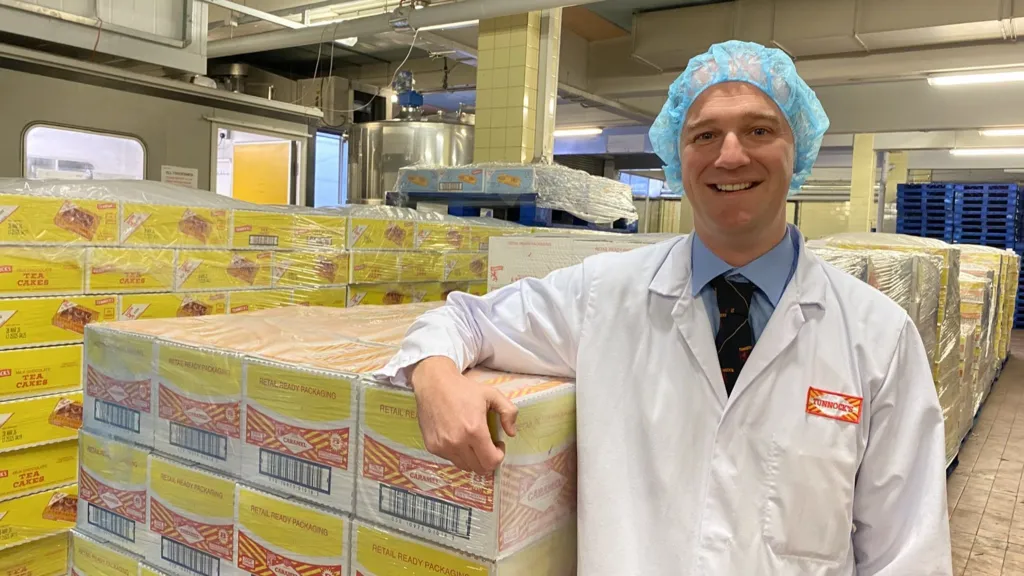
As a smaller player in the snack food industry, Tunnock's must adapt to stay competitive with larger companies like McVitie's and Fox's, and investing in advanced technology has been crucial in this endeavor.
Mr Louden emphasizes the importance of utilizing cutting-edge machines to maintain output and remain competitive, stating that as a "small fish in a big pond," the company must be strategic in its use of technology.
Although machines are used to spread caramel at night, the human workforce offers greater flexibility and requires less space, making it an essential component of the production process.
The combined efforts of humans and machines result in the production of approximately seven million wafer bars and 4.5 million tea cakes every week.
For Tunnock's, increasing output while preserving traditional methods is a delicate balancing act, one that requires careful consideration of the company's heritage and values.
The production of marshmallow, like caramel, is closely monitored by human supervisors to ensure the highest quality and consistency.
The company's commitment to traditional methods is also evident in its approach to packaging, where the wafer bar is wrapped rather than sealed, a decision that prioritizes quality over speed.
Mr Louden notes that the company's products often evoke nostalgic memories, with many customers recalling their childhood experiences with Tunnock's treats.
A new robotic arm developed for the cake industry aims to bridge the gap between traditional techniques and modern automation, offering a potential solution for companies like Tunnock's.
Unifiller, a technology brand of Coperion Group, has spent years developing the HIRO robot arm, designed to decorate cakes with a variety of toppings, including caramel.
The HIRO robot arm is capable of handling a range of toppings and can be used with various decorating tips, providing a high level of flexibility and precision.
According to Derek Lanoville, research and development manager at Coperion, the robot arm can work with any topping that can be squeezed through a pastry bag, making it a versatile tool for cake decoration.
Developing equipment for the food industry poses unique challenges, with hygiene being a top priority; equipment must be easy to disassemble and clean to prevent contamination.
Mr Lanoville emphasizes the importance of designing equipment that is easy to clean, stating that if it is not simple to disassemble, it may not be properly cleaned, compromising hygiene standards.
Unifiller collaborated with Swiss robotics firm Stäubli to develop the HIRO robot arm, which features a design that prioritizes ease of cleaning and maintenance.
Another challenge in the food industry is the inherent variability of products like cakes, which can differ in size and shape, posing a challenge for automation.
In most industries, components are uniform in size, but in baking, cakes can vary slightly in size and shape, requiring equipment that can accommodate these differences.
Mr Lanoville notes that the HIRO robot arm is designed to adapt to these variations, ensuring that it can decorate cakes accurately and efficiently, even when they are not perfectly uniform.
For Anomarel Ogen, head baker at The Bread Factory, human involvement is essential to the baking process, particularly when it comes to handling delicate dough.
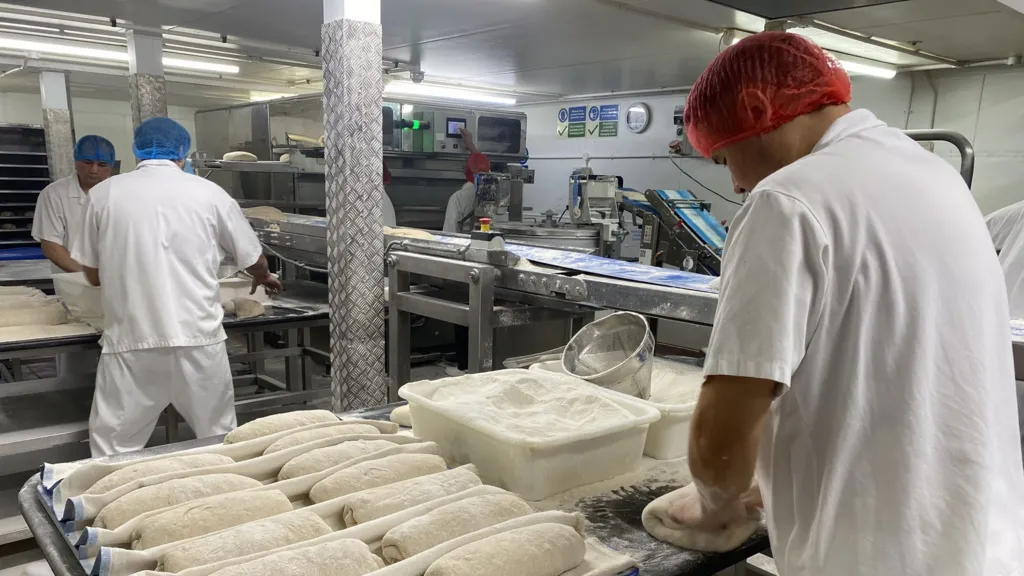
The Bread Factory, which supplies products to the café chain Gail's, operates 24 hours a day, 365 days a year, and produces up to 40,000 loaves daily using around 16 tonnes of flour.
Although the bakery uses machines to mix and divide the dough, the process still requires a high level of human oversight and skill, particularly when working with sustainable, delicate flours.
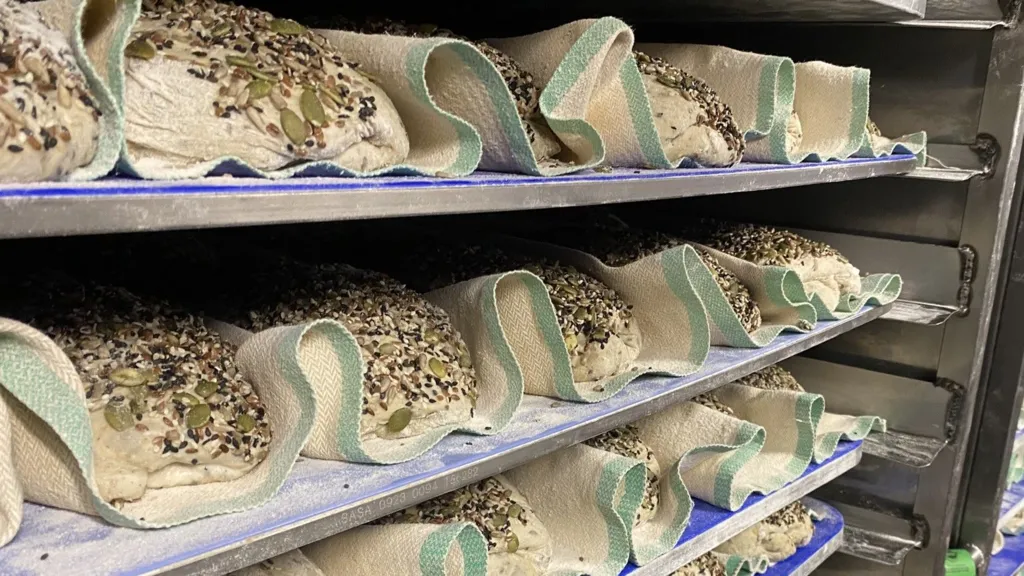
The bakery's use of sustainable flours, which prioritize soil health, results in a more delicate dough that demands gentle handling and careful monitoring.
Machines are used to mix and divide the dough, but human workers play a crucial role in shaping the loaves, a task that requires years of experience and skill.
The bakery's commitment to sustainability is evident in its choice of flours, which are sourced from farms that prioritize soil health and environmentally friendly practices.
Mr Ogen highlights the importance of gentle handling when working with delicate dough, noting that the worker's touch and movement are critical in shaping the loaves.
The presence of human workers in the factory also allows for greater flexibility and adaptability, enabling the bakery to adjust its production process in response to changes in the recipe or dough.
As Mr Ogen notes, having staff on hand to monitor the production process and make adjustments as needed is essential for maintaining quality and consistency.
Introducing new technology to a production line requires a careful balance between automation and human oversight, according to Craig Le Clair, principal analyst at Forrester.
Mr Le Clair emphasizes the importance of developing a hybrid model that integrates automation with human involvement, preserving the unique qualities of handcrafted products while improving efficiency and consistency.
He notes that automation should be applied only to areas where it can bring significant benefits, such as speed, volume, and consistency, while leaving core value-added elements to human workers.
This approach allows companies to leverage the advantages of automation while preserving the essence of their products and the skills of their human workforce.
At Coperion, Mr Lanoville is already planning to develop the HIRO robot arm further, exploring new applications and refinements to enhance its performance and versatility in the cake decorating process.
The current priority is to refine the company's scanning, vision, and safety systems, allowing customers to work seamlessly without robotic interference.
In Glasgow, Mr. Louden is considering an upgrade to his production line, but the project's feasibility depends on the current financial climate, which has been affected by fluctuating cocoa prices over the past two years.
With a potential investment of £2.5 million in equipment, the company is adopting a cautious approach, delaying the decision due to the unfavorable market conditions of the past two years, and seeking to avoid any financial risks that could have a negative impact.
News
UAE Defeats Canada to Enhance Super 8s Qualification Chances
The United Arab Emirates boosted their slim chances of advancing to the T20 World Cup Super 8s, securing a narrow five-wicket victory over Canada, thanks in part to Aryansh Sharma’s unbeaten 74.
In a crucial match for the United Arab Emirates, Aryansh Sharma achieved his fifth T20 international half-century, contributing to the team's victory over Canada.
The Men's T20 World Cup, being held in Group D in Delhi, saw an intense competition between the two teams.
Canada's innings resulted in a total of 150-7 after 20 overs, with Harsh Thaker scoring 50 runs off 41 balls, while Junaid Siddique took 5 wickets for 35 runs.
The UAE team responded with a total of 154 runs in 19.4 overs, led by Aryansh Sharma's unbeaten 74 runs off 53 balls and Sohaib Khan's 51 runs off 29 balls, despite Bin Zafar taking 3 wickets for 14 runs.
The United Arab Emirates secured a five-wicket win over Canada, boosting their chances in the tournament.
Aryansh Sharma played a pivotal role in the UAE's win, scoring an unbeaten 74 runs to help his team overcome Canada's total.
With four overs remaining, Canada seemed poised to defend their total, but Sohaib Khan's aggressive batting reignited the UAE's chase, as he scored 17 runs off Dillon Heyliger's bowling.
In the final over, the UAE required eight runs to win, and Aryansh Sharma eased the pressure by hitting a six off Jaskaran Singh's first ball.
Sohaib Khan was dismissed after scoring a rapid 51 runs off 29 balls, including four sixes, leaving the scores level.
Muhammad Arfan then sealed the victory with two balls to spare, hitting a four off Jaskaran Singh, as Aryansh Sharma top-scored with 74 runs off 53 balls.
The UAE now stands third in Group D with two points, but they face an uphill task in their upcoming matches against full members South Africa and Afghanistan to advance to the next phase.
Although the UAE has never beaten a full member in any World Cup format, their performance in this match has given them some confidence.
Earlier in the match, Junaid Siddique achieved the best bowling figures by a UAE player in a T20 World Cup, taking 5 wickets for 35 runs at the Arun Jaitley Stadium in Delhi.
Harsh Thaker's 41-ball half-century, which included three sixes and two fours, provided a solid foundation for Canada's total.
Thaker and Navneet Dhaliwal shared a 58-run partnership to help Canada recover from a difficult start, before Dhaliwal was run out for 34 runs.
After Thaker fell victim to Junaid Siddique's slower ball, Canada struggled to find boundaries against the UAE's tight bowling.
Shreyas Movva made a useful contribution of 21 runs off 21 balls, but Junaid Siddique took two wickets in the final over to claim his maiden five-wicket haul in T20 internationals.
In a separate match, Zimbabwe's Brilliant Muzarabani played a key role in his team's stunning win over Australia.
For more updates, notifications, and social media coverage, visit the BBC Sport website.
In another development, Paul Stirling has been ruled out of the remainder of the T20 World Cup due to injury.
News
GB’s Bankes knocked out in snowboard cross quarterfinals
Charlotte Bankes of Great Britain was knocked out in the quarter-final stage of the women’s snowboard cross event at the 2026 Winter Olympics.
Charlotte Bankes of Great Britain has been knocked out of the women's snowboard cross event at the 2026 Winter Olympics, failing to advance beyond the quarter-final stage.
For more Winter Olympics coverage, videos are available to stream.
Access to Winter Olympics video content is restricted to users in the United Kingdom.
News
Family of Murder Victim Expresses Frustration Over Delayed Trial Scheduling
A 21-year-old woman, Chloe Mitchell, lost her life in June 2023, and a man is set to stand trial, facing a murder charge.
The family of Chloe Mitchell, a 21-year-old woman from Ballymena, is facing further uncertainty as they await the outcome of a trial for her alleged murderer, which may be impacted by an ongoing barristers' strike.

Chloe Mitchell's life was cut short in June 2023, when she was killed in an incident that has left her family and community in shock.
Brandon John Rainey, the man accused of her murder, is scheduled to stand trial on February 23, but the proceedings may be delayed due to the industrial action by defence barristers.
Following a recent court hearing to review trial arrangements, Nadine Mitchell, Chloe's sister, expressed her family's distress and frustration, telling BBC News NI that they are struggling to cope with the uncertainty.
Nadine Mitchell stated that her family has been left with no choice but to wait once again for a resolution, having already endured a prolonged period of anxiety and uncertainty.
The family's emotional turmoil is evident, with Nadine describing the experience as a prolonged period of distress, marked by sleepless nights and unbearable tension.
The Mitchell family is struggling to come to terms with their situation, which has left them feeling overwhelmed and distraught.
The current strike by defence barristers in Northern Ireland, which began last month, is a result of a long-standing dispute over legal aid fees, with barristers arguing that their fees have not kept pace with inflation.
The strike has brought almost all criminal trials in Northern Ireland to a standstill, with the exception of cases where the defendant does not require legal aid.
The Mitchell family has appealed for their case to be treated as an exception, allowing the trial to proceed as scheduled.
Chloe Mitchell, who was 21 at the time of her disappearance, was reported missing in early June 2023, prompting an extensive search operation.
Her remains were discovered about a week later, following a series of searches in the Ballymena area.
Brandon John Rainey was subsequently arrested and charged with Chloe's murder, which is alleged to have taken place between June 2 and June 5, 2023.
Rainey also faces a charge of attempting to prevent the lawful burial of a deceased body.
The dispute between barristers and the Department of Justice centres on the level of legal aid fees, which barristers claim have not increased since 2005.

Barristers argue that the fees have not kept pace with inflation, resulting in a significant decrease in their real-terms value over the past 20 years.
The Criminal Bar Association (CBA) has warned that the low fees have created a crisis in the justice system, with many younger barristers refusing to take on legal aid cases due to the low rates of pay.
The CBA has described the strike as a "last resort" in their dispute with the Department of Justice, which has been ongoing for some time.
Despite an announced 16% increase in fees, which is set to take effect in mid-January, the strike has continued, with barristers arguing that the increase does not go far enough to address their concerns.
Chloe's father, George Mitchell, has previously appealed for an exception to be made in their case, allowing the trial to proceed despite the strike.
George Mitchell has argued that any delay to the trial would cause further trauma and distress for the families of victims.
He had invited Justice Minister Naomi Long to meet with him and his wife, Georgina, to discuss the matter further.
However, Minister Long has stated that it is not feasible to allow individual cases to proceed while the dispute over legal aid fees remains unresolved, citing ethical and practical concerns.
The minister has reiterated that the decision to grant exceptions lies with the CBA, which must weigh the competing demands of their members and the needs of the justice system.
-
 News11 hours ago
Australian Politics Faces Questions Over Gender Equality Amid Sussan Ley’s Appointment
-
 News8 hours ago
Farage Says Reform to Replace Traditional Tory Party
-
 News8 hours ago
Wrexham Pair Seek Win Against Former Team Ipswich
-
 News13 hours ago
Liberal Party Removes Australia’s First Female Leader
-
 News11 hours ago
UK Braces for Cold Snap with Snow and Ice Alerts Expected
-
 News8 hours ago
Husband’s alleged £600k theft for sex and antiques blamed on drug side effects
-
 News2 days ago
Sunbed ads spreading harmful misinformation to young people
-
 Business14 hours ago
BBC Reporter Exposed to Cyber Attack Due to Vulnerabilities in AI Coding Tool