
News
The Potential of 3D Printing in Boat Manufacturing
Companies in the Netherlands are investing in the use of 3D printing technology to manufacture hulls, with the expectation that it will lead to more affordable boat production.
A rigorous test was conducted, with Maarten Logtenberg using a sledgehammer to strike a sample of the new material. The results were impressive, as the hammer bounced off with minimal impact, leaving only a slight mark.
Following a two-year period of experimentation, a breakthrough was achieved in developing a unique blend of thermoplastics and fibreglass. This innovative material boasts exceptional strength, requires no additional coating for UV protection, and exhibits resistance to fouling and marine growth.
According to Mr Logtenberg, this material provides an ideal foundation for 3D printing a boat, offering a range of benefits that make it an attractive option for marine applications.
The marine environment is notoriously harsh, and boats must be designed to withstand its unforgiving conditions. This is one reason why traditional boatbuilding is often a labor-intensive and time-consuming process.
However, after months of fine-tuning the material's chemistry, CEAD was able to produce its first hull in just four days at its new factory. This marked a significant milestone in the company's efforts to revolutionize boatbuilding.
Mr Logtenberg notes that CEAD is automating nearly 90% of the boat-building process, significantly reducing production time. This streamlined approach enables the company to produce boats at a much faster rate than traditional methods.
Typically, building a hull takes several weeks. In contrast, CEAD can now print one every week, demonstrating the potential of 3D printing to transform the boatbuilding industry.
The story of CEAD's innovative approach to boatbuilding is one that 3D printing has long promised to deliver: a rapid, labor-saving production process that substantially reduces costs.
Although 3D printing has not always lived up to its promises, Mr Logtenberg is convinced that the maritime sector is an area where this technology can have a profound impact.
As co-founder of CEAD, a company specializing in the design and construction of large-format 3D printers, Mr Logtenberg has been at the forefront of this innovation. CEAD is based in the Dutch town of Delft.
Until now, CEAD's primary focus has been on providing 3D printers for other companies to use. However, with the advent of boatbuilding, the company has decided to expand its role and become involved in production as well.
Mr Logtenberg acknowledges that 3D printed boats still need to gain acceptance in the market. To address this, CEAD has taken a proactive approach, deciding to produce boats itself rather than simply providing the necessary equipment.
According to Mr Logtenberg, investors are often hesitant to commit to new technologies without a clear indication of market demand. By taking a hands-on approach to production, CEAD aims to demonstrate the viability of 3D printed boats and drive market growth.
Traditional fibreglass boatbuilding requires a mold and significant manual labor to ensure the vessel meets the required strength standards. In contrast, additive manufacturing streamlines this process by completing the necessary work at the design stage.
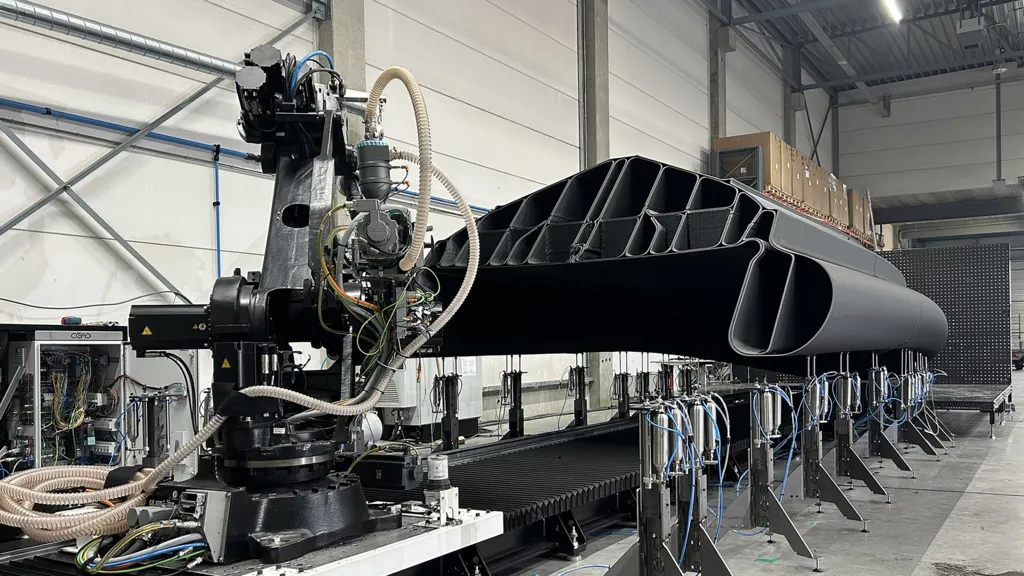
The design stage involves creating the software and printer, which can be a labor-intensive process. However, once this initial work is completed, the production phase can proceed with minimal human intervention.
3D printers operate by building up thin layers of material, following a predetermined digital design. This process enables the creation of complex objects with high precision.
As each layer is added, it bonds to the previous one, allowing for the formation of a single, seamless object. This approach enables the production of objects with intricate geometries and structures.
During the production phase, the primary requirement is a steady supply of the base material. With this in place, human intervention is minimal, and the production process can proceed autonomously.
One of the key benefits of additive manufacturing is the ability to make design adjustments without significant changes to the build process. This flexibility enables companies to respond quickly to changing market demands or customer requirements.
While 3D printing has made significant inroads in various industries, including dentistry, its application in boatbuilding poses unique challenges. Creating a vessel capable of withstanding real-world marine conditions requires a distinct approach.
CEAD's largest 3D printer, measuring nearly 40m in length, has been used to print an electric ferry for a customer in Abu Dhabi. This project demonstrates the company's ability to produce large, complex vessels using additive manufacturing.
Since establishing its Marine Application Centre in Delft, CEAD has made significant progress in boatbuilding. In the past 12 months, the company has produced a prototype 12m fast boat for the Dutch Navy, similar to a RIB.
Mr Logtenberg notes that traditionally, the Dutch Navy would have to wait years for a new boat, incurring significant costs. In contrast, CEAD was able to deliver the prototype in just six weeks, at a fraction of the cost.
Furthermore, CEAD can learn from the prototype and produce another vessel in the same timeframe, with the added benefit of being able to recycle the original boat. This approach enables rapid iteration and improvement.
Another area where 3D printing is gaining traction is in the production of unmanned vessels, such as nautical drones. CEAD recently participated in a test with Nato Special Forces, where drones were built on-site in a matter of hours, with designs adapting to operational requirements.
According to Mr Logtenberg, the flexibility of 3D printing is a major advantage. By relocating production closer to the end-user, companies can respond quickly to changing demands and reduce logistics costs.
Even large 3D printers can be transported in shipping containers, allowing for deployment in remote or hard-to-reach locations. This mobility enables companies to produce boats and other vessels in a variety of settings.
The size of the vessel is not a limiting factor, as the 3D printing process can accommodate a wide range of designs. As long as the base material is available, the machine can produce boats of varying sizes, from small work boats to larger military vessels.
The only logistical consideration is the transportation of the base material, which is highly efficient due to its compact packaging. In contrast, traditional boatbuilding often requires the transportation of large, finished vessels.
In the port city of Rotterdam, a company called Raw Idea, with its 'Tanaruz' brand, is exploring the potential of 3D printing in the leisure market, particularly in boat rentals.
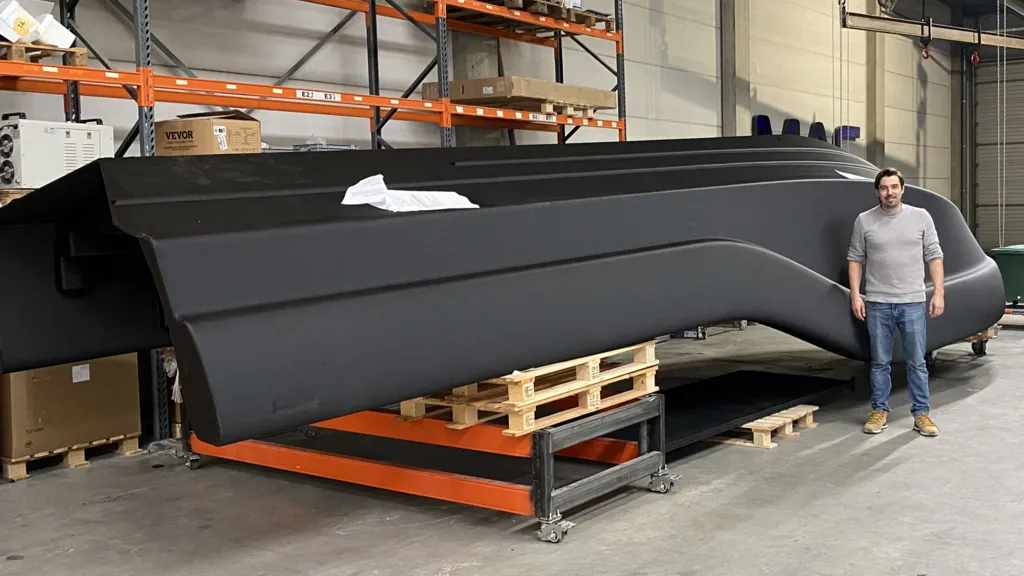
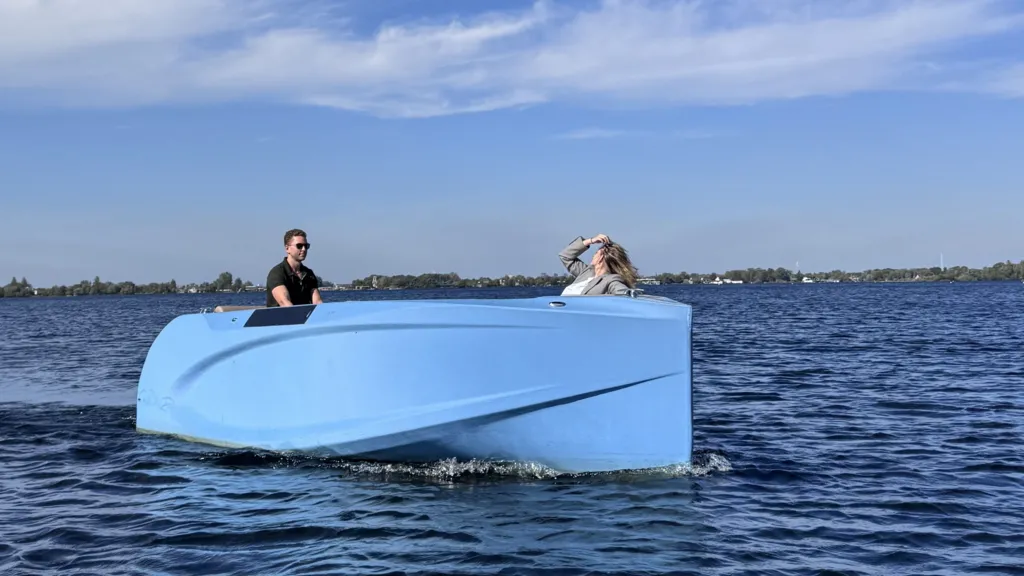
Joyce Pont, Raw Idea's managing director, notes that while consumers may be hesitant to adopt 3D printed boats due to their novelty, the rental market is showing significant interest. The unique aspect of 3D printed boats can be a major marketing draw.
The use of social media platforms can help generate buzz around 3D printed boats, with customers eager to experience and share their encounters with these innovative vessels.
Raw Idea is also highlighting the eco-friendly aspect of its 3D printed boats, which are made from a combination of glass fiber and recycled consumer plastics, such as fizzy drink bottles.
Although the current cost of 3D printed boats is comparable to traditional vessels, the use of recycled materials increases production costs. However, as the technology scales up and becomes more efficient, costs are expected to decrease significantly.
Ms Pont is confident that within five years, 3D printed boats will dominate the market for fast-driving boats, such as work boats and speed boats, due to their improved performance and reduced production costs.
The marine industry is heavily regulated, and certification authorities are working to keep pace with the rapid innovation in 3D printing. Both Raw Idea and CEAD are engaging with European regulators to ensure compliance with existing standards.
As the industry continues to evolve, regulators must adapt to the unique characteristics of 3D printed boats, which often cannot be directly compared to traditional vessels.
The development of new materials and production methods is driving innovation in the marine sector, with companies like Raw Idea and CEAD at the forefront of this change.
While 3D printing has often been touted as a revolutionary technology, its impact has been uneven across different industries. Mr Logtenberg attributes this to the diverse range of applications and contexts in which 3D printing is used.
The varied nature of 3D printing applications can make it challenging to assess the technology's overall impact, as different industries and use cases may experience distinct benefits and challenges.
The field of additive manufacturing encompasses various applications, including metal printing, polymer printing, and large-scale printing, each with its own unique uses.
While some additive manufacturing applications have failed to gain traction due to competitiveness issues, others have successfully implemented the technology and are currently utilizing it.
Additive manufacturing is gaining traction in the shipping industry, albeit in specialized areas, rather than being used to construct entire ship hulls.
The potential of 3D printing in the maritime sector is still being explored, but the idea of printing entire ships in one process remains a distant goal.
Joyce Pont expresses doubts about the feasibility of automated shipbuilding in the near future, viewing the construction of luxury vessels like superyachts as a craft that will likely resist automation.
In contrast, Mr Logtenberg holds a more positive outlook on the future of additive manufacturing in shipbuilding.
Mr Logtenberg notes that he did not anticipate being able to build a 12-meter boat just a year ago, highlighting the rapid progress being made in the field.
Traditional shipbuilding involves a modular approach, and it may take around a decade or two for additive manufacturing to reach the point where entire ship hulls can be printed, pending further research into suitable materials.
As thermal plastics continue to be developed and improved, and machinery is scaled up, the possibilities for additive manufacturing in shipbuilding are expanding, raising the question of what can be achieved in the future.
News
UAE Defeats Canada to Enhance Super 8s Qualification Chances
The United Arab Emirates boosted their slim chances of advancing to the T20 World Cup Super 8s, securing a narrow five-wicket victory over Canada, thanks in part to Aryansh Sharma’s unbeaten 74.
In a crucial match for the United Arab Emirates, Aryansh Sharma achieved his fifth T20 international half-century, contributing to the team's victory over Canada.
The Men's T20 World Cup, being held in Group D in Delhi, saw an intense competition between the two teams.
Canada's innings resulted in a total of 150-7 after 20 overs, with Harsh Thaker scoring 50 runs off 41 balls, while Junaid Siddique took 5 wickets for 35 runs.
The UAE team responded with a total of 154 runs in 19.4 overs, led by Aryansh Sharma's unbeaten 74 runs off 53 balls and Sohaib Khan's 51 runs off 29 balls, despite Bin Zafar taking 3 wickets for 14 runs.
The United Arab Emirates secured a five-wicket win over Canada, boosting their chances in the tournament.
Aryansh Sharma played a pivotal role in the UAE's win, scoring an unbeaten 74 runs to help his team overcome Canada's total.
With four overs remaining, Canada seemed poised to defend their total, but Sohaib Khan's aggressive batting reignited the UAE's chase, as he scored 17 runs off Dillon Heyliger's bowling.
In the final over, the UAE required eight runs to win, and Aryansh Sharma eased the pressure by hitting a six off Jaskaran Singh's first ball.
Sohaib Khan was dismissed after scoring a rapid 51 runs off 29 balls, including four sixes, leaving the scores level.
Muhammad Arfan then sealed the victory with two balls to spare, hitting a four off Jaskaran Singh, as Aryansh Sharma top-scored with 74 runs off 53 balls.
The UAE now stands third in Group D with two points, but they face an uphill task in their upcoming matches against full members South Africa and Afghanistan to advance to the next phase.
Although the UAE has never beaten a full member in any World Cup format, their performance in this match has given them some confidence.
Earlier in the match, Junaid Siddique achieved the best bowling figures by a UAE player in a T20 World Cup, taking 5 wickets for 35 runs at the Arun Jaitley Stadium in Delhi.
Harsh Thaker's 41-ball half-century, which included three sixes and two fours, provided a solid foundation for Canada's total.
Thaker and Navneet Dhaliwal shared a 58-run partnership to help Canada recover from a difficult start, before Dhaliwal was run out for 34 runs.
After Thaker fell victim to Junaid Siddique's slower ball, Canada struggled to find boundaries against the UAE's tight bowling.
Shreyas Movva made a useful contribution of 21 runs off 21 balls, but Junaid Siddique took two wickets in the final over to claim his maiden five-wicket haul in T20 internationals.
In a separate match, Zimbabwe's Brilliant Muzarabani played a key role in his team's stunning win over Australia.
For more updates, notifications, and social media coverage, visit the BBC Sport website.
In another development, Paul Stirling has been ruled out of the remainder of the T20 World Cup due to injury.
News
GB’s Bankes knocked out in snowboard cross quarterfinals
Charlotte Bankes of Great Britain was knocked out in the quarter-final stage of the women’s snowboard cross event at the 2026 Winter Olympics.
Charlotte Bankes of Great Britain has been knocked out of the women's snowboard cross event at the 2026 Winter Olympics, failing to advance beyond the quarter-final stage.
For more Winter Olympics coverage, videos are available to stream.
Access to Winter Olympics video content is restricted to users in the United Kingdom.
News
Family of Murder Victim Expresses Frustration Over Delayed Trial Scheduling
A 21-year-old woman, Chloe Mitchell, lost her life in June 2023, and a man is set to stand trial, facing a murder charge.
The family of Chloe Mitchell, a 21-year-old woman from Ballymena, is facing further uncertainty as they await the outcome of a trial for her alleged murderer, which may be impacted by an ongoing barristers' strike.

Chloe Mitchell's life was cut short in June 2023, when she was killed in an incident that has left her family and community in shock.
Brandon John Rainey, the man accused of her murder, is scheduled to stand trial on February 23, but the proceedings may be delayed due to the industrial action by defence barristers.
Following a recent court hearing to review trial arrangements, Nadine Mitchell, Chloe's sister, expressed her family's distress and frustration, telling BBC News NI that they are struggling to cope with the uncertainty.
Nadine Mitchell stated that her family has been left with no choice but to wait once again for a resolution, having already endured a prolonged period of anxiety and uncertainty.
The family's emotional turmoil is evident, with Nadine describing the experience as a prolonged period of distress, marked by sleepless nights and unbearable tension.
The Mitchell family is struggling to come to terms with their situation, which has left them feeling overwhelmed and distraught.
The current strike by defence barristers in Northern Ireland, which began last month, is a result of a long-standing dispute over legal aid fees, with barristers arguing that their fees have not kept pace with inflation.
The strike has brought almost all criminal trials in Northern Ireland to a standstill, with the exception of cases where the defendant does not require legal aid.
The Mitchell family has appealed for their case to be treated as an exception, allowing the trial to proceed as scheduled.
Chloe Mitchell, who was 21 at the time of her disappearance, was reported missing in early June 2023, prompting an extensive search operation.
Her remains were discovered about a week later, following a series of searches in the Ballymena area.
Brandon John Rainey was subsequently arrested and charged with Chloe's murder, which is alleged to have taken place between June 2 and June 5, 2023.
Rainey also faces a charge of attempting to prevent the lawful burial of a deceased body.
The dispute between barristers and the Department of Justice centres on the level of legal aid fees, which barristers claim have not increased since 2005.

Barristers argue that the fees have not kept pace with inflation, resulting in a significant decrease in their real-terms value over the past 20 years.
The Criminal Bar Association (CBA) has warned that the low fees have created a crisis in the justice system, with many younger barristers refusing to take on legal aid cases due to the low rates of pay.
The CBA has described the strike as a "last resort" in their dispute with the Department of Justice, which has been ongoing for some time.
Despite an announced 16% increase in fees, which is set to take effect in mid-January, the strike has continued, with barristers arguing that the increase does not go far enough to address their concerns.
Chloe's father, George Mitchell, has previously appealed for an exception to be made in their case, allowing the trial to proceed despite the strike.
George Mitchell has argued that any delay to the trial would cause further trauma and distress for the families of victims.
He had invited Justice Minister Naomi Long to meet with him and his wife, Georgina, to discuss the matter further.
However, Minister Long has stated that it is not feasible to allow individual cases to proceed while the dispute over legal aid fees remains unresolved, citing ethical and practical concerns.
The minister has reiterated that the decision to grant exceptions lies with the CBA, which must weigh the competing demands of their members and the needs of the justice system.
-
 News11 hours ago
Australian Politics Faces Questions Over Gender Equality Amid Sussan Ley’s Appointment
-
 News8 hours ago
Farage Says Reform to Replace Traditional Tory Party
-
 News8 hours ago
Wrexham Pair Seek Win Against Former Team Ipswich
-
 News13 hours ago
Liberal Party Removes Australia’s First Female Leader
-
 News11 hours ago
UK Braces for Cold Snap with Snow and Ice Alerts Expected
-
 News8 hours ago
Husband’s alleged £600k theft for sex and antiques blamed on drug side effects
-
 News2 days ago
Sunbed ads spreading harmful misinformation to young people
-
 Business14 hours ago
BBC Reporter Exposed to Cyber Attack Due to Vulnerabilities in AI Coding Tool