
News
Soaring Costs Leave Pharmacists Struggling with £145k Debt
Pharmacies are incurring losses on vital products like aspirin due to rising expenses.
A pharmacist's efforts to keep his business afloat have resulted in a significant debt of £145,000, leaving him concerned about meeting his monthly staff payroll obligations.

Tunde Olawoye's struggles are not unique, as many pharmacists in Wales are facing similar challenges due to rising costs, forcing them to sell essential items like aspirin at a loss.
According to the National Pharmacy Association, approximately 60% of pharmacy owners in Wales have resorted to remortgaging their homes or using personal savings to keep their businesses operational over the past year.
The Welsh government claims to have made substantial investments in the sector in recent years, including increased funding for core services aimed at implementing reforms.
Geoff Thomas, a pharmacist with 40 years of experience, warns that the industry is on the brink of collapse unless drastic changes are made.
Another pharmacist revealed that she purchases aspirin for £3.75 and sells it for £3.05, resulting in a financial loss.
Olawoye, 54, stated that the current situation is "not sustainable at all."
He emphasized the need for increased investment in the profession, highlighting the crucial role pharmacists play as the frontline of healthcare in the country.
Initially, Olawoye's business was performing well, but escalating costs eventually outpaced his reimbursement through the Welsh government agreement, leaving him struggling to cover overheads.
As his debt reached £145,000, he was forced to establish a repayment plan to satisfy his creditors.
Olawoye considered selling his business in New Quay, Ceredigion, but realized the sale proceeds would be insufficient to cover his bank loans.
He described the daily challenges he faces, saying, "These are the difficulties we deal with every day."
Olawoye has decided not to sell his business at a loss and is instead exploring ways to make it profitable again.
In Wales, community pharmacies are primarily funded through the Community Pharmacy Contractual Framework, which covers various costs, including dispensing fees and operational expenses.

The framework involves an agreement between pharmacy owners and the Welsh government, outlining the reimbursement amount for services such as dispensing, professional fees, and clinical services.
A 4% increase in the framework was announced in November 2025, bringing the total annual funding to £182m.
However, pharmacy owners argue that this increase is insufficient, as the funding has not kept pace with rising costs over the past decade.
The challenges faced by pharmacists in Wales are not unique, as analysis has shown that England's pharmacy network has shrunk to its smallest size in 20 years due to closures.
Pharmacy services in Northern Ireland were also reported to be "at breaking point" last year due to funding difficulties.
Gwawr Jones, a pharmacist from Barry, Vale of Glamorgan, stated that her costs have increased significantly, driven by inflation and rising drug prices, while funding remains stagnant.
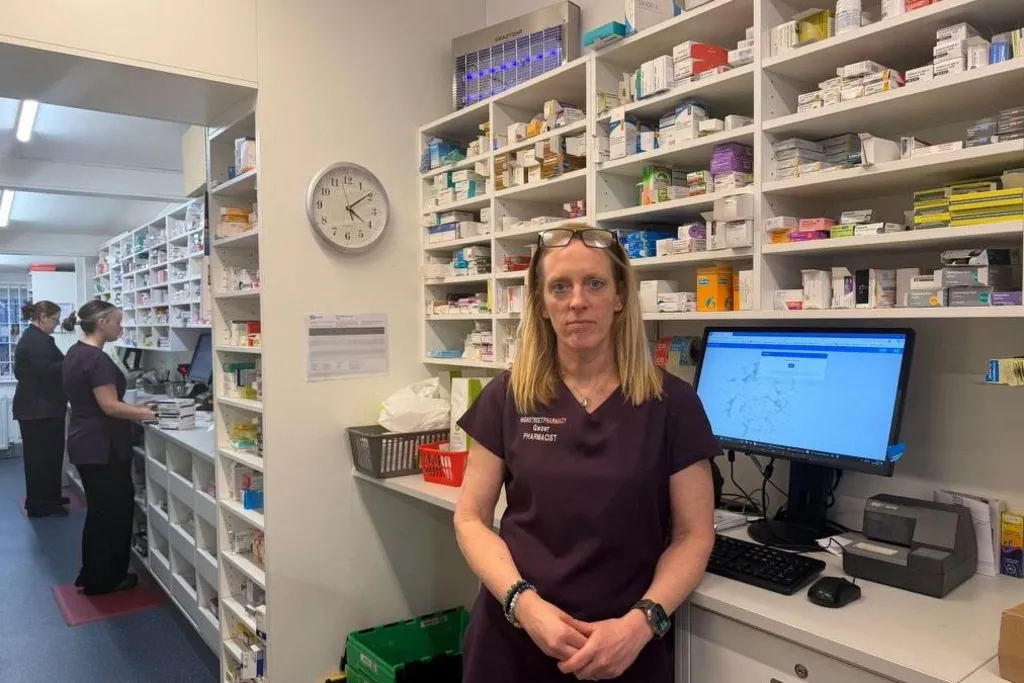
Jones pays £3.75 for 75mg of aspirin but can only sell it for £3.05 due to the funding agreement, resulting in a loss of 70p per box.
She noted that pharmacies may receive a drug concession at the end of the month, increasing the reimbursement cost, but this is only known after dispensing several hundred boxes to patients.
Jones described the November funding increase as insufficient, saying it "has not even touched the sides."
She finds running a pharmacy in Rhoose "impossible" in the current financial climate, the worst she has seen in 26 years.
Jones cited increases in the national living wage, national insurance, energy costs, and fuel costs as additional pressures on the industry.
She acknowledged that other industries face similar challenges but noted that the pharmacy sector's reliance on NHS income through the Welsh government makes it difficult for owners to find a solution.
Jones estimated a £40m shortfall due to contract payments not keeping pace with pharmacy inflation, placing a significant burden on owners to keep pharmacies operational.
Thomas, who has worked in the industry for 40 years, warned of increasing peril in the sector.
He believes that Wales is "heading off a cliff" unless significant changes are made to address the challenges faced by pharmacists.
Thomas explained that pharmacies are forced to purchase drugs at a higher cost than they can be reimbursed for, leaving little margin for staff salaries, deliveries, and other expenses.
He noted that pharmacies are becoming busier as GPs direct patients to them to alleviate pressure on the health service, but this increased workload is not matched by adequate funding.

Thomas stated that the current reimbursement structure has not changed, despite the growing demands on pharmacies.
He expressed his desire to provide services and care for patients but emphasized that the current situation is unsustainable.
Thomas admitted that he is currently focused on "keeping the show on the road" but acknowledged that this cannot continue indefinitely.
He revealed that he took out a short-term loan of £70,000 last September to cover expenses for the month.
Thomas emphasized the need for urgent action to address the challenges faced by pharmacists in Wales.
He warned that the consequences of inaction would be severe, with potential closures of pharmacies and reduced access to healthcare services.
Thomas called for a comprehensive review of the funding structure and reimbursement rates to ensure the long-term sustainability of the pharmacy sector.
He urged policymakers to recognize the critical role pharmacists play in the healthcare system and to provide adequate support to ensure their continued operation.
Thomas concluded that the future of community pharmacies in Wales depends on prompt and effective action to address the current challenges and ensure the sector's viability.
After over 20 years at the helm, the owner of this establishment is now indebted to the bank for an amount exceeding twice the original purchase price of the pharmacy.
The NPA has recently published its latest set of statistics, which are based on a survey of its members in Wales.
The data reveals that in 2025, nearly 40% of Welsh pharmacies were operating at a loss, leaving them in a precarious financial situation.
According to David Thomas, a Welsh board member, the survey's findings should serve as a warning to the Welsh government.
Thomas stated that it is unreasonable to expect pharmacy owners to resort to remortgaging their homes and depleting their retirement savings to cover prescription costs and keep their businesses afloat for the sake of their patients.
The Welsh government has acknowledged the vital role that community pharmacies play in primary care.
A government spokesperson noted that funding for community pharmacies has increased by more than £40m since the reforms began in 2017.
This increase includes above-inflation rises in recurrent funding over the past two years, as well as a £6m stability payment to address specific cost pressures and over £1m in grants to support premises improvements at more than 100 pharmacies across Wales.
The spokesperson also explained that the reimbursement amount for medicines dispensed by pharmacies is determined through consultation with industry representatives, using data on the prices paid to suppliers.
The government stated that pharmacies generally receive higher reimbursement rates from the NHS than they pay to suppliers, allowing them to maintain a profit margin.
Although some medicines may be reimbursed at a rate below their cost on occasion, this is typically offset by the profits generated from the majority of medicines that pharmacies dispense.
News
GB men’s curling team suffers upset defeat to Italy
At the 2026 Winter Olympics, Great Britain’s men’s curling team mounted a comeback against Italy following a disappointing beginning, ultimately falling short in their inaugural match.
Despite a valiant comeback, Team GB ultimately fell short as Italy held their composure to secure the win in the final end.
A dismal start to the match proved costly for Team GB's men, as they suffered their first defeat of the Winter Olympics at the hands of host nation Italy, despite a spirited fightback in the packed Cortina Curling Stadium.
Following victories in their first two matches, including a win over the Swedish rink that beat them in the gold-medal match four years ago, Team GB entered their second high-profile encounter in as many days in a confident position.
However, a disastrous opening end, in which Italy stole four points, left Team GB trailing and facing an uphill battle in front of a boisterous home crowd.
The British team, currently ranked number one in the world, gradually regained their footing and managed to level the score by the ninth end.
Ultimately, Italy maintained their composure in the final end to emerge victorious, winning 9-7 and adding Team GB to their list of scalps, which already included the Swedes.
"We had to dig deep and play some solid curling, but unfortunately, it wasn't enough to get us over the line," Team GB lead Hammy McMillan said in an interview with BBC Sport.
With seven wins from nine round-robin matches guaranteeing a spot in the semi-finals, Team GB remains in a strong position, although fewer wins may still be sufficient to advance.
The women's team is set to take to the ice next, facing South Korea in their second match at 13:05 GMT, while the men will return to action on Saturday against the Czech Republic at the same time.
Team GB is at the forefront of curling's technological advancements.
Embracing what sets you apart can be a powerful asset, according to some athletes.
A daily guide to the Winter Olympics is available for those looking to stay up-to-date with the action.
The looks of shock on the faces of Team GB's curlers told the story of a disastrous opening end.
With a stone in play, Mouat attempted a risky shot in an effort to claim two points, but it backfired, resulting in none of Team GB's stones in the house and four Italian stones in position.
However, the Scottish quartet, ranked number one in the world, quickly regained their composure and got back to their game.
The teams exchanged singles before a impressive final throw by Mouat, aided by a measurement to determine which stone was closest to the button, allowed Team GB to claim two points and narrow the gap to 5-3.
Another excellent team effort, which included a well-judged throw by Mouat, a solid sweep by Hammy McMillan and Bobby Lammie, and Grant Hardie's strategic expertise, forced Italy to concede a point in the fourth end, reducing the deficit to a single point at the break.
Italy blanked the sixth end and added two points in the seventh to rebuild their lead, but Team GB fought back with two points of their own, remarkably levelling the score with one end remaining after a steal.
The match came down to the final end, but Italy held their nerve to secure the win, prompting a deafening roar from the crowd.
"It's an incredible experience, and we need to get used to it," McMillan added, describing the electric atmosphere as "surreal" and "cool," more akin to a football match than a typical curling crowd.
News
Scotland Kicks Off Nations League Against Slovenia
Uefa has released the schedule for the Nations League, with Scotland set to begin their campaign on 26 September with an away match against Slovenia.
Uefa has released the schedule for the Nations League, with Scotland's campaign set to begin on 26 September with an away match against Slovenia.
The team's six group stage games will be played within a three-month period, culminating in a match against Switzerland on 16 November.
The fixture list was announced following Thursday's draw, which placed Scotland in a group with Switzerland, Slovenia, and North Macedonia.
Having been relegated from League A after a play-off loss to Greece last year, Scotland will compete in the second tier of the Nations League this year.
In response to the draw, head coach Steve Clarke noted that the teams in the group appear to be evenly matched.
Clarke reflected on the team's past experience in the competition, stating that it has been beneficial for Scotland.
He emphasized the importance of the Nations League, citing its role in helping the team qualify for Euro 2020, and anticipated a challenging set of matches.
A key matchup in the Nations League will see Scotland face off against Switzerland.
The group stage will determine the teams' fates, with the winner earning promotion, the runner-up entering a play-off, the third-placed team facing a relegation play-off, and the fourth-placed team being relegated directly.
The upcoming group games will mark a reunion for Scotland and Switzerland, who previously drew 1-1 in Cologne at Euro 2024.
Scotland's last encounter with Slovenia was during the 2018 World Cup qualification campaign, when they won 1-0 at home and drew 2-2 away.
The team has not played North Macedonia since the 2014 World Cup qualifiers, when they drew 1-1 at home and won 2-1 away, with goals from Ikechi Anya and Shaun Maloney.
The schedule for Scotland's Nations League campaign begins on 26 September with a match against Slovenia.
The team will then host Switzerland on 29 September, followed by a trip to face North Macedonia on 3 October.
Scotland will then play Slovenia at home on 6 October, before hosting North Macedonia on 11 November.
The final group stage match will see Scotland travel to face Switzerland on 16 November.
The team's home match against North Macedonia is set for 11 November.
The campaign will conclude with an away match against Switzerland on 16 November.
News
Golfer McIlroy Sinks Bunker Shot at Pebble Beach Pro-Am
At the AT&T Pebble Beach Pro-Am in California, Rory McIlroy achieved an eagle on the 14th hole at Spyglass Hill, capping off his opening round with a score of 68.
During the AT&T Pebble Beach Pro-Am in California, Rory McIlroy achieved an eagle on the 14th hole at Spyglass Hill, contributing to his first-round score of 68.
For further information, Rory McIlroy had a solid opening round, while Hisatsune took the lead.
Access to this content is restricted to users in the United Kingdom.
-
 News8 hours ago
Australian Politics Faces Questions Over Gender Equality Amid Sussan Ley’s Appointment
-
 News5 hours ago
Farage Says Reform to Replace Traditional Tory Party
-
 News5 hours ago
Wrexham Pair Seek Win Against Former Team Ipswich
-
 News11 hours ago
Liberal Party Removes Australia’s First Female Leader
-
 News9 hours ago
UK Braces for Cold Snap with Snow and Ice Alerts Expected
-
 News5 hours ago
Husband’s alleged £600k theft for sex and antiques blamed on drug side effects
-
 News2 days ago
Sunbed ads spreading harmful misinformation to young people
-
 Business11 hours ago
BBC Reporter Exposed to Cyber Attack Due to Vulnerabilities in AI Coding Tool