
News
New research on Uranus’ moons increases likelihood of life discovery
Researchers have reevaluated their understanding of Uranus and its five largest moons, suggesting they may not be as barren as previously believed.
New research challenges the long-held notion that Uranus and its five largest moons are barren and lifeless, suggesting that these celestial bodies may actually harbor oceans and potentially support life.

A reexamination of data from NASA's Voyager 2 spacecraft, which visited the Uranian system nearly 40 years ago, has led scientists to reconsider their initial assessment of the planet and its moons.
Voyager 2's 1986 flyby provided a wealth of information about the Uranian system, but its visit coincided with a intense solar storm that may have skewed the data, resulting in an incomplete understanding of the system.
The new analysis reveals that the solar storm's impact on the Uranian system's magnetic field and the surrounding environment may have led to inaccurate conclusions about the planet's and moons' activity levels.
Located in the outer reaches of the solar system, Uranus is a unique and fascinating planet, distinguished by its icy composition, ring system, and extreme axial tilt, which sets it apart from other planets.
The 1986 Voyager 2 flyby marked the first close encounter with Uranus, yielding stunning images and valuable data that have been the basis for scientific study and speculation about the planet and its moons.
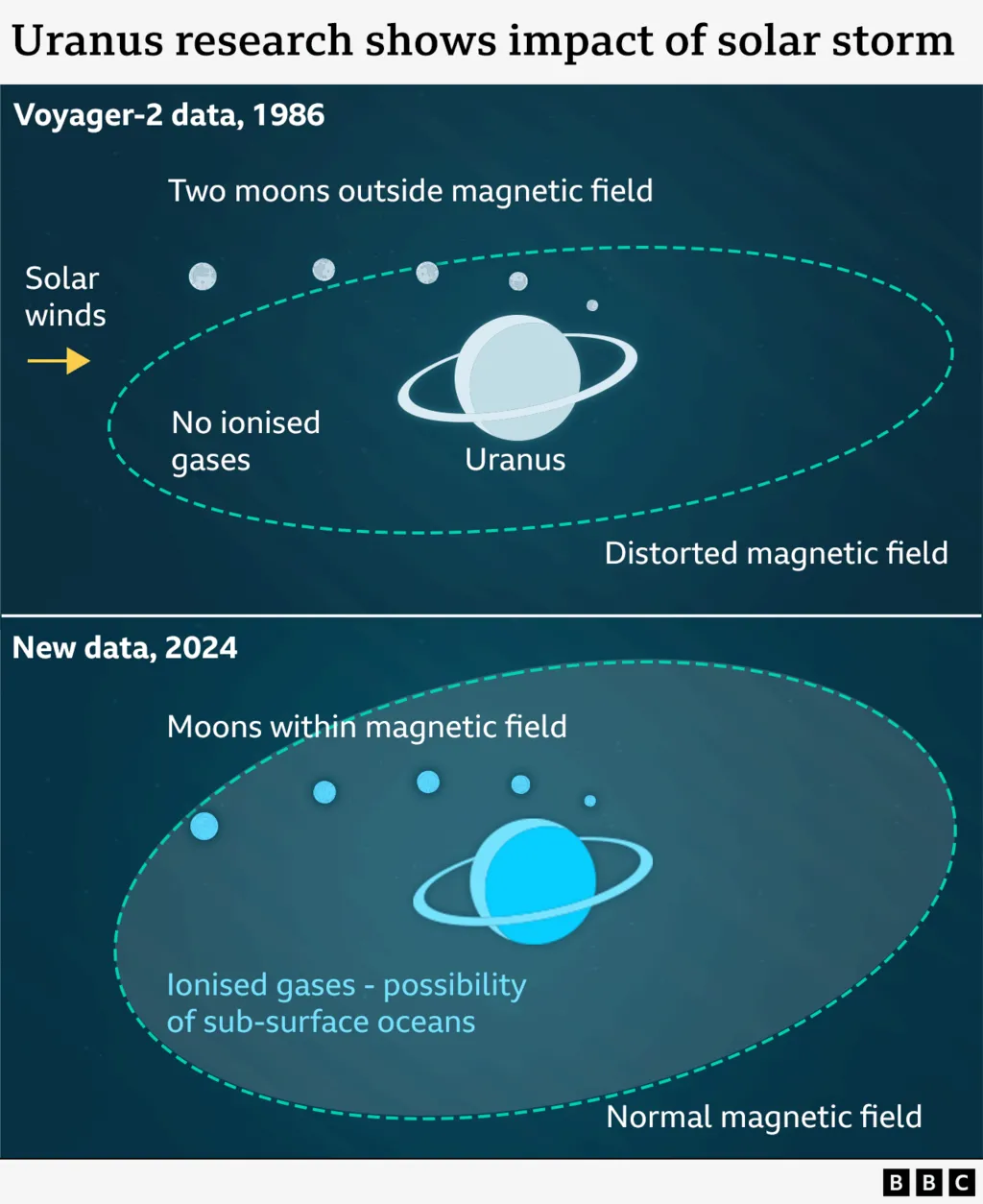
However, the data from Voyager 2 also raised more questions than answers, as the measurements indicated that the Uranian system was eerily quiet, with no signs of geological activity or oceanic presence, puzzling scientists.
The spacecraft's instruments detected a distorted magnetic field, which was compressed and pushed away from the Sun, suggesting that the planet and its moons were devoid of activity and lacking in gases and other materials.
This discovery was surprising, as it differed from the characteristics of other planets and moons in the solar system, leading scientists to conclude that Uranus and its largest moons were inactive and sterile.
The new research, however, offers an alternative explanation for the unexpected findings, suggesting that the solar storm during the Voyager 2 flyby may have temporarily altered the Uranian system's appearance.
According to the new study, the timing of Voyager 2's visit coincided with a period of intense solar activity, which may have blown away material and distorted the magnetic field, resulting in an inaccurate representation of the system.

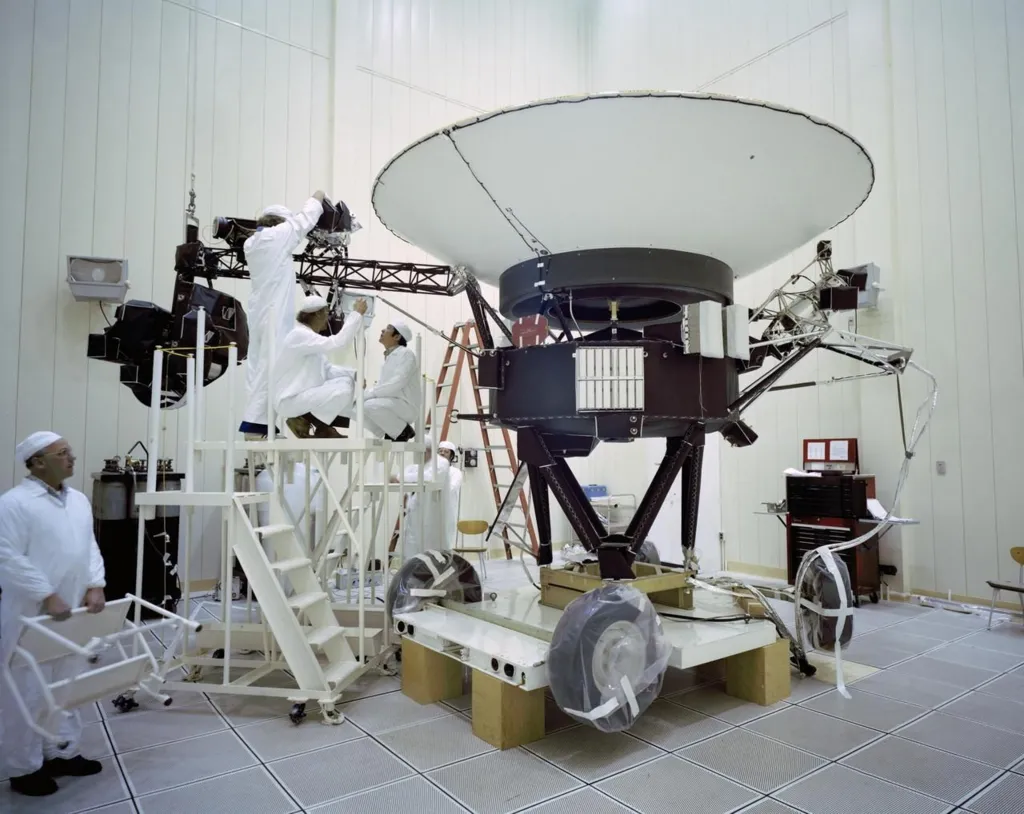
The reanalysis of the Voyager 2 data indicates that the solar wind during the flyby may have masked the true nature of the Uranian system, leading to a misunderstanding of its characteristics.
Dr. William Dunn of University College London notes that the new findings imply that the Uranian system may be more dynamic and potentially life-supporting than previously thought, with the possibility of moons harboring subsurface oceans.
"The results suggest that the Uranian system could be more exciting than we thought, with conditions that could support life," Dr. Dunn explains, highlighting the possibility of discovering life beyond Earth.
Linda Spilker, a veteran scientist who worked on the Voyager program and is now the project scientist for the Voyager missions, welcomes the new research, published in the Journal Nature Astronomy, and its implications for the search for life.

"The results are fascinating, and I'm excited to see the potential for life in the Uranian system," Spilker tells BBC News, emphasizing the significance of the discovery.
Spilker also praises the ongoing analysis of Voyager data, which continues to yield new insights and discoveries, demonstrating the value of revisiting and reevaluating existing data.
Dr. Affelia Wibisono of the Dublin Institute for Advanced Studies, an independent expert, describes the findings as "very exciting," highlighting the importance of reexamining old data to uncover new knowledge.
The research underscores the value of revisiting and reanalyzing existing data, which can lead to new discoveries and inform the design of future space missions, such as NASA's planned Uranus Orbiter and Probe.
The new mission, scheduled to launch in 10 years, will build upon the discoveries made by Voyager 2 and the new research, aiming to provide a more comprehensive understanding of the Uranian system.
NASA's Dr. Jamie Jasinski, who initiated the reexamination of the Voyager 2 data, notes that the new findings will be taken into account when designing the instruments and planning the scientific survey for the upcoming mission.
The future spacecraft will need to be equipped with instruments capable of capturing the true nature of the Uranian system, rather than being influenced by abnormal events like the solar storm during the Voyager 2 flyby.

The mission's success will depend on the careful design of its instruments and the incorporation of lessons learned from the Voyager 2 encounter, ensuring that the new spacecraft can provide accurate and comprehensive data about the Uranian system.
The anticipated arrival of the Uranus probe in 2045 is expected to mark a major milestone in the search for life beyond Earth, as scientists hope to determine whether the icy moons of Uranus, once thought to be dead and barren, may actually harbor the conditions necessary to support life.
Entertainment And Arts
Spielberg Contributes $25,000 to Van Der Beek’s $2 Million Crowdfunding Campaign
The relatives of the deceased actor, known for his role in Dawson’s Creek, have expressed gratitude to those who contributed to the $2m fund.
A donation of $25,000 (£21,000) has been made by film director Steven Spielberg and his wife, Kate Capshaw, to a GoFundMe campaign that has raised over $2m (£1.6m) for the family of late actor James Van Der Beek.

Van Der Beek, who passed away at the age of 48, is survived by his wife Kimberly and their six children, and the crowdfunding effort to support his family has now exceeded its initial target of $2m.
Other notable donors include Oscar-winning actress Zoe Saldana, who contributed $2,500 (£2,108), and director Jon M Chu, who gave $10,000 (£8,432) to the cause.
A statement from the organizers of the fundraiser, Friends of the Van Der Beek family, expressed gratitude to all contributors, stating that their support is deeply appreciated.
The statement highlighted the significance of the donations, saying that the kindness shown by contributors is beyond words.
It also noted that the outpouring of support has been a source of comfort during a difficult time, serving as a reminder of the power of love, community, and the enduring legacy of James Van Der Beek.
Van Der Beek was perhaps best known for his starring role in the popular US teen drama series Dawson's Creek, which aired from 1998 to 2003, although he remained associated with the show until 2023.
Although Van Der Beek and Spielberg never collaborated on a project, the late actor's character in Dawson's Creek was a fan of Spielberg's work, with posters of films like ET and Schindler's List featured in his bedroom.
At a Dawson's Creek cast reunion event last year, Spielberg paid tribute to Van Der Beek by sending a video message.
In the message, Spielberg said, "Dawson, you made it," and jokingly added that he hoped to one day have a room like Dawson's, filled with memorabilia from his films.
Van Der Beek passed away on Wednesday after a battle with bowel cancer.

He had been dealing with the diagnosis since August 2023 and publicly disclosed his condition in November 2024.
The GoFundMe campaign was launched to help the family with medical expenses, which had depleted their funds.
The statement from the organizers concluded by saying that the family is currently taking time to grieve and be together, and thanked everyone for their compassionate and generous support in honoring James Van Der Beek's life.
News
Zimbabwe Shocks Australia with Muzarabani’s Exceptional Performance
Zimbabwe secured a stunning 23-run victory over Australia in the T20 World Cup, with Blessing Muzarabani playing a key role by taking 4-17.
In the current T20 world rankings, Zimbabwe occupies the 12th position.
The Men's T20 World Cup is underway in Group B at Colombo.
Zimbabwe's innings concluded at 169-2 after 20 overs, with Bennett scoring an unbeaten 64 off 56 deliveries, while Green claimed 1-6.
Australia's reply ended at 146 after 19.3 overs, as Renshaw top-scored with 65 off 44 balls, and Muzarabani took 4-17.
The match resulted in a 23-run victory for Zimbabwe.
A standout performance from Blessing Muzarabani, who took 4-17, helped Zimbabwe secure a thrilling 23-run win over Australia in the T20 World Cup.
After being set a target of 170, Australia found themselves in trouble at 29-4, but a 77-run partnership between Matthew Renshaw and Glenn Maxwell for the fifth wicket gave them hope.
With 34 runs needed from the last two overs, Renshaw's dismissal for 65, caught off Muzarabani with eight balls remaining, essentially sealed the game's outcome.
The result has left Group B finely balanced after two matches each, with Australia trailing Zimbabwe and Sri Lanka by two points, ahead of their meeting with Sri Lanka on Monday.
Initially, Zimbabwe's approach to batting first at the R. Premadasa Stadium appeared overly cautious.
Brian Bennett's innings of 64 not out from 56 balls, including seven fours, was played at a strike rate of 114.28, as he anchored the Zimbabwean batting.
In contrast, Tadiwanashe Marumani and Ryan Burl adopted a more aggressive approach, scoring 35 off 21 and 30 balls, respectively.
A late surge from Zimbabwe skipper Sikandar Raza, who scored 25 off 13 balls, including the team's only six on the final ball, provided a boost to their total.
Australia's target seemed achievable, given their total of 182-6 in their previous win against Ireland.
However, the Australian batting line-up was severely dented by the loss of key wickets, including Josh Inglis, Travis Head, Cameron Green, and Tim David, courtesy of Muzarabani and Brad Evans.
A partnership between Renshaw and Maxwell offered some respite, but when Maxwell fell for 31, dragged on to Burl, the pressure mounted on Australia.
Muzarabani's return to bowl the penultimate over proved decisive, as he removed Renshaw, and Zimbabwe subsequently wrapped up the win.
There are calls for the ICC to review the rules regarding 12th men.
For more information, including notifications and social media updates, visit BBC Sport.
A blogger who participates in the FPL is also competing in the T20 World Cup.
News
FA Cup Finalists Outside the Big Six Since 2008
As the FA Cup resumes this weekend, assess your understanding of past finalists that have competed from beyond the Premier League’s top six clubs.
This weekend, the FA Cup resumes with 32 teams remaining in contention for the historic trophy, which has been awarded for 155 years and will be presented to the winner in May.
Historically, the Premier League's top six clubs – Arsenal, Chelsea, Liverpool, Manchester City, Manchester United, and Tottenham – have dominated the FA Cup, claiming 32 titles out of the last 37.
However, in recent years, teams outside of this elite group have experienced some notable victories in the competition.
Since 2008, 10 teams from outside the traditional 'big six' have advanced to the FA Cup final – can you identify all of them?
For more quizzes, visit our Football Quizzes and Sports Quizzes sections, where you can also subscribe to receive the latest quizzes directly on your device.
We have a quiz question tailored to each Premier League team – test your knowledge and see how you score.
Can you recall every team that has won the Women's Champions League?
Which players have made the most appearances in the Premier League – can you name them all?
Explore our Sports Quizzes page for a wide range of challenging and engaging quizzes.
-
 News7 hours ago
Australian Politics Faces Questions Over Gender Equality Amid Sussan Ley’s Appointment
-
 News4 hours ago
Farage Says Reform to Replace Traditional Tory Party
-
 News4 hours ago
Wrexham Pair Seek Win Against Former Team Ipswich
-
 News9 hours ago
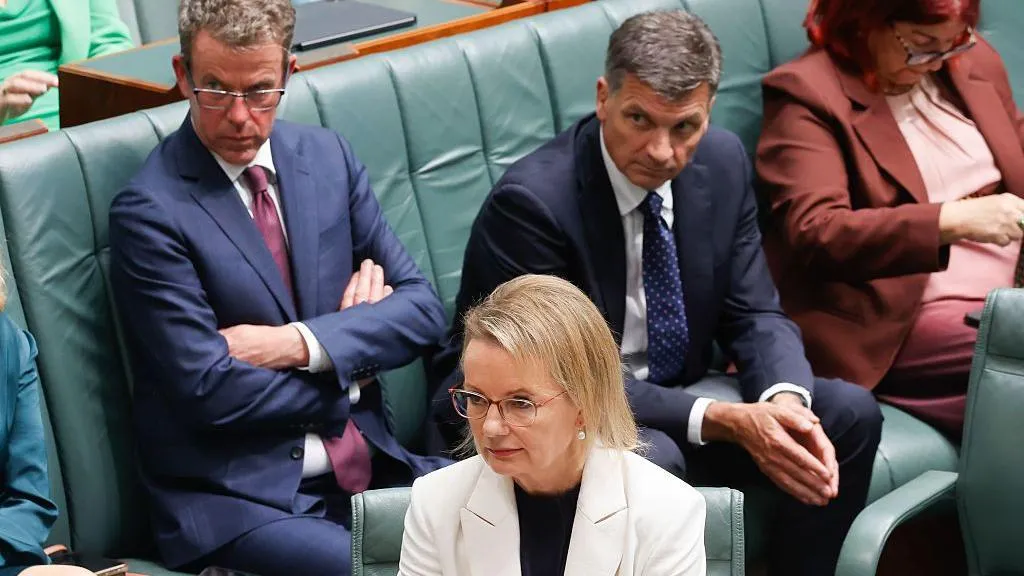
Liberal Party Removes Australia’s First Female Leader
-
 News7 hours ago
UK Braces for Cold Snap with Snow and Ice Alerts Expected
-
 News4 hours ago
Husband’s alleged £600k theft for sex and antiques blamed on drug side effects
-
 News2 days ago
Sunbed ads spreading harmful misinformation to young people
-
 Business10 hours ago
BBC Reporter Exposed to Cyber Attack Due to Vulnerabilities in AI Coding Tool