
News
Archaeologists uncover rare Iron Age war trumpet and boar standard
According to the archaeologists involved in the excavation, these findings are extremely uncommon.
A groundbreaking excavation has unearthed two exceedingly rare Iron Age artifacts, leaving archaeologists in awe of the discovery.
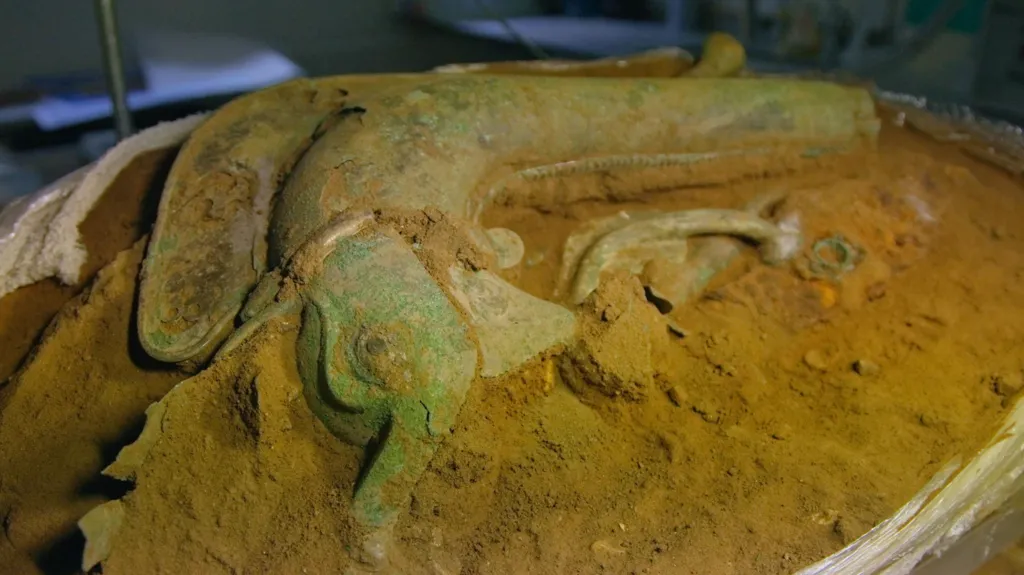
The excavation team from Pre-Construct Archaeology made the find at a building site near Thetford, Norfolk, during their work in the previous year.
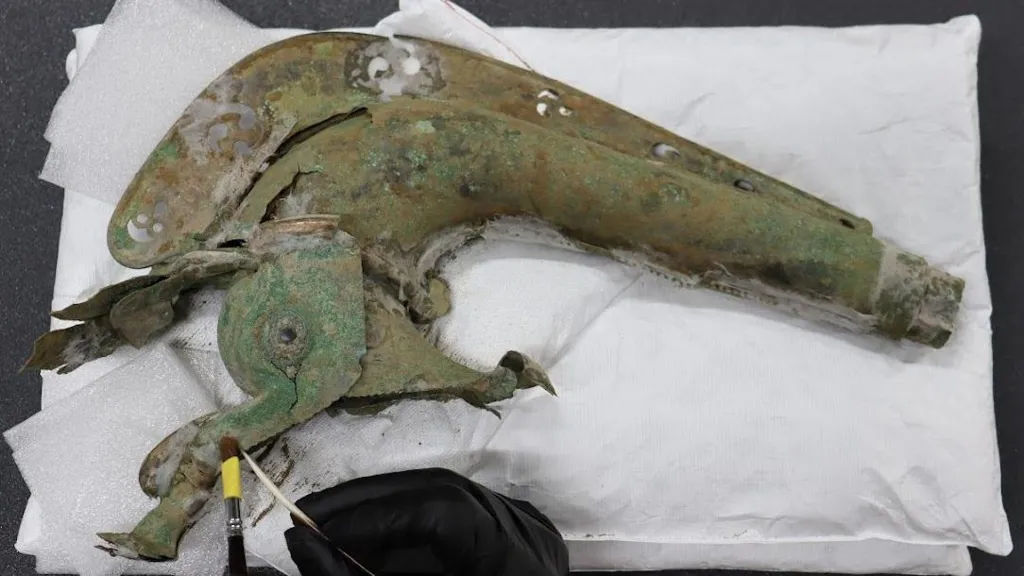
The discovery included a remarkably well-preserved battle trumpet, known as a carnyx, which is the most complete example ever found in Europe, as well as a boar's head flag standard, the first of its kind to be discovered in Britain.
According to Gary Trimble, senior project officer, the carnyx is an exceptionally rare find, and the boar standard is even more unusual, making this discovery particularly significant.
Trimble emphasized that while Norfolk has had its share of notable discoveries, this find stands out as particularly unique and special.
Prior to the excavation, dig leader Peter Crawley had a hunch that the site might yield something extraordinary.
Crawley described the site as one of those rare locations that occasionally produce exceptional discoveries, giving him an instinctive feeling about its potential.
The war trumpet, or carnyx, was a key instrument used by Celtic tribes across Europe to intimidate their enemies and guide their warriors during battles.
The Iceni tribe, led by Queen Boudica, who launched a rebellion against the Romans in AD60-61, was among the Celtic tribes that utilized such instruments.
The Romans were fascinated by carnyces, often depicting them as symbols of war in their art and literature.
Conservator Jonathan Carr noted that the Thetford discovery was crafted from extremely thin metal sheets that had become brittle over the course of 2,000 years underground.
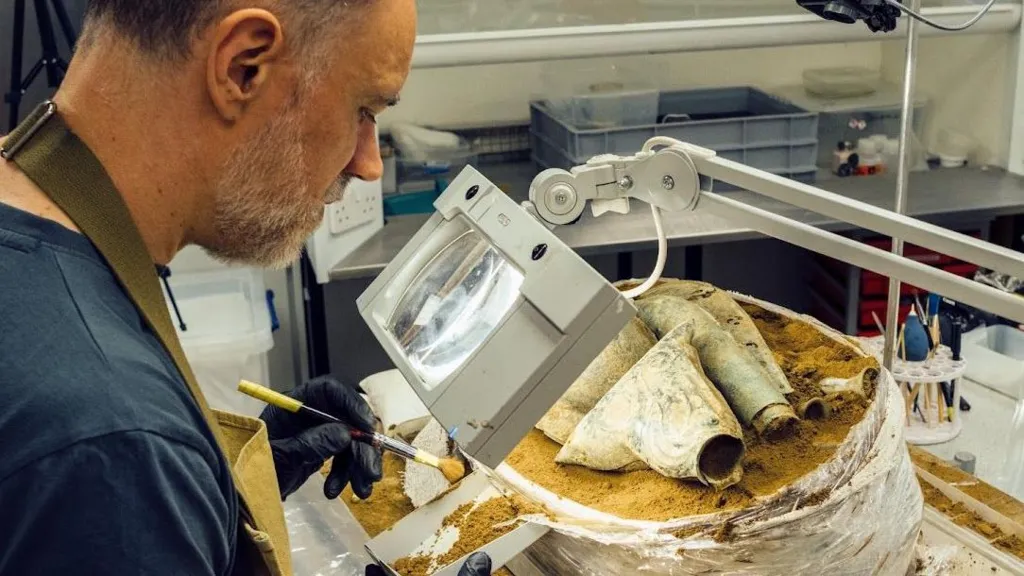
This carnyx is not only one of only three found in Britain but also the most complete example, with its pipe, mouthpiece, and bell all intact, according to Carr.
Dr. Fraser Hunter, curator of Iron Age and Roman artifacts at National Museums Scotland, stated that a thorough examination and conservation of these fragile remains will significantly enhance our understanding of sound and music in the Iron Age.
The boar's head standard, made from sheet bronze, would have been used as a rallying point for troops and held aloft during battles.
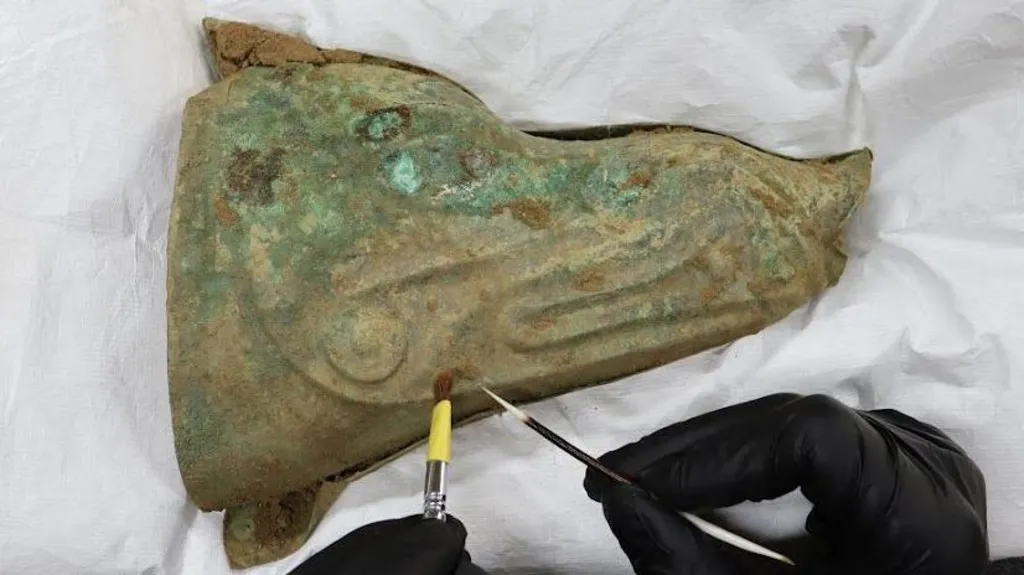
Hunter explained that the boar symbolized strength, given its ferocity in the wild, making it an apt emblem for battle.
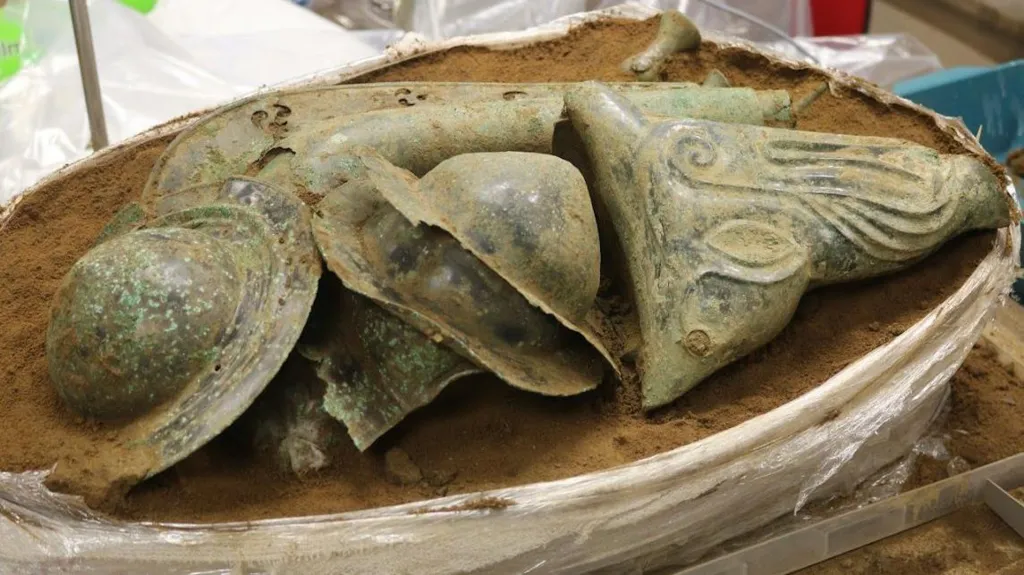
The hoard, which dates back to around 50BC-AD50, includes five shield bosses and an iron object of unknown origin, in addition to the carnyx and boar standard.
After its discovery, the hoard was carefully extracted from the earth in a block of soil and scanned to determine the positioning of the artifacts before conservation efforts began.
The find has been reported to the coroner, and an inquest will be held to determine whether it qualifies as treasure, with its long-term fate still to be decided.
Historic England is collaborating with Pre-Construct Archaeology, Norfolk Museums Service, and the National Museum of Scotland to oversee the research and conservation of the finds.
Dr. Tim Pestell, senior curator of archaeology at Norfolk Museums Service, noted that this discovery serves as a powerful reminder of Norfolk's Iron Age heritage, which continues to captivate the public through the story of Boudica and the Iceni people.

The Norfolk Carnyx Hoard presents archaeologists with a unique opportunity to investigate these rare objects and ultimately shed light on the story of how they came to be buried in the county 2,000 years ago.
Claudia Kenyatta CBE and Emma Squire CBE, co-CEOs of Historic England, described the discovery as "remarkable" and expressed their enthusiasm for uncovering and sharing the story of the community that once owned and used these artifacts.
The co-CEOs of Historic England look forward to exploring and sharing the story of the Norfolk community that owned and utilized these items.
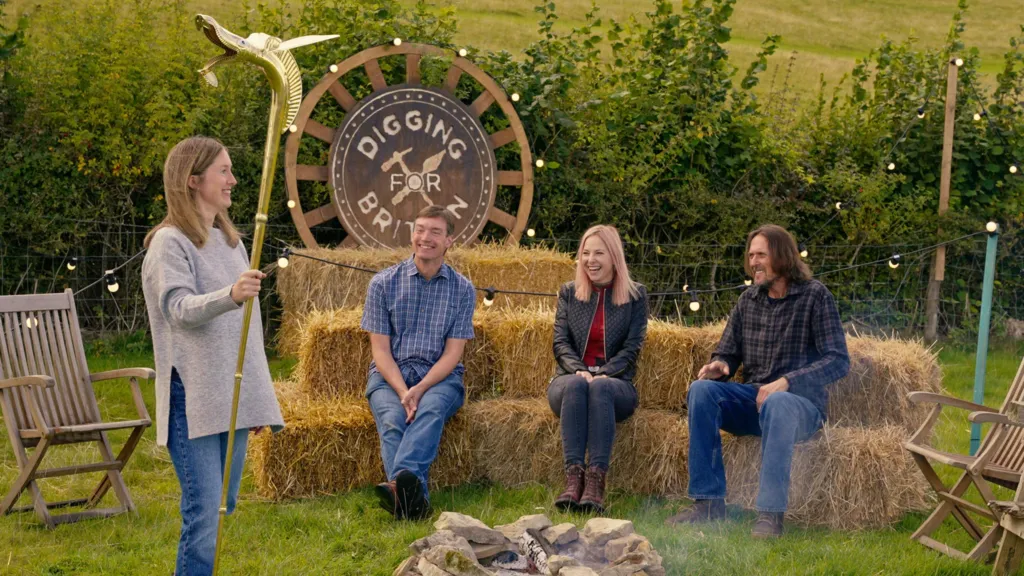
The story of the discovery will be featured on BBC Two's Digging for Britain, airing on 14 January at 21:00 GMT, and will also be available on BBC iPlayer.
News
GB men’s curling team suffers upset defeat to Italy
At the 2026 Winter Olympics, Great Britain’s men’s curling team mounted a comeback against Italy following a disappointing beginning, ultimately falling short in their inaugural match.
Despite a valiant comeback, Team GB ultimately fell short as Italy held their composure to secure the win in the final end.
A dismal start to the match proved costly for Team GB's men, as they suffered their first defeat of the Winter Olympics at the hands of host nation Italy, despite a spirited fightback in the packed Cortina Curling Stadium.
Following victories in their first two matches, including a win over the Swedish rink that beat them in the gold-medal match four years ago, Team GB entered their second high-profile encounter in as many days in a confident position.
However, a disastrous opening end, in which Italy stole four points, left Team GB trailing and facing an uphill battle in front of a boisterous home crowd.
The British team, currently ranked number one in the world, gradually regained their footing and managed to level the score by the ninth end.
Ultimately, Italy maintained their composure in the final end to emerge victorious, winning 9-7 and adding Team GB to their list of scalps, which already included the Swedes.
"We had to dig deep and play some solid curling, but unfortunately, it wasn't enough to get us over the line," Team GB lead Hammy McMillan said in an interview with BBC Sport.
With seven wins from nine round-robin matches guaranteeing a spot in the semi-finals, Team GB remains in a strong position, although fewer wins may still be sufficient to advance.
The women's team is set to take to the ice next, facing South Korea in their second match at 13:05 GMT, while the men will return to action on Saturday against the Czech Republic at the same time.
Team GB is at the forefront of curling's technological advancements.
Embracing what sets you apart can be a powerful asset, according to some athletes.
A daily guide to the Winter Olympics is available for those looking to stay up-to-date with the action.
The looks of shock on the faces of Team GB's curlers told the story of a disastrous opening end.
With a stone in play, Mouat attempted a risky shot in an effort to claim two points, but it backfired, resulting in none of Team GB's stones in the house and four Italian stones in position.
However, the Scottish quartet, ranked number one in the world, quickly regained their composure and got back to their game.
The teams exchanged singles before a impressive final throw by Mouat, aided by a measurement to determine which stone was closest to the button, allowed Team GB to claim two points and narrow the gap to 5-3.
Another excellent team effort, which included a well-judged throw by Mouat, a solid sweep by Hammy McMillan and Bobby Lammie, and Grant Hardie's strategic expertise, forced Italy to concede a point in the fourth end, reducing the deficit to a single point at the break.
Italy blanked the sixth end and added two points in the seventh to rebuild their lead, but Team GB fought back with two points of their own, remarkably levelling the score with one end remaining after a steal.
The match came down to the final end, but Italy held their nerve to secure the win, prompting a deafening roar from the crowd.
"It's an incredible experience, and we need to get used to it," McMillan added, describing the electric atmosphere as "surreal" and "cool," more akin to a football match than a typical curling crowd.
News
Scotland Kicks Off Nations League Against Slovenia
Uefa has released the schedule for the Nations League, with Scotland set to begin their campaign on 26 September with an away match against Slovenia.
Uefa has released the schedule for the Nations League, with Scotland's campaign set to begin on 26 September with an away match against Slovenia.
The team's six group stage games will be played within a three-month period, culminating in a match against Switzerland on 16 November.
The fixture list was announced following Thursday's draw, which placed Scotland in a group with Switzerland, Slovenia, and North Macedonia.
Having been relegated from League A after a play-off loss to Greece last year, Scotland will compete in the second tier of the Nations League this year.
In response to the draw, head coach Steve Clarke noted that the teams in the group appear to be evenly matched.
Clarke reflected on the team's past experience in the competition, stating that it has been beneficial for Scotland.
He emphasized the importance of the Nations League, citing its role in helping the team qualify for Euro 2020, and anticipated a challenging set of matches.
A key matchup in the Nations League will see Scotland face off against Switzerland.
The group stage will determine the teams' fates, with the winner earning promotion, the runner-up entering a play-off, the third-placed team facing a relegation play-off, and the fourth-placed team being relegated directly.
The upcoming group games will mark a reunion for Scotland and Switzerland, who previously drew 1-1 in Cologne at Euro 2024.
Scotland's last encounter with Slovenia was during the 2018 World Cup qualification campaign, when they won 1-0 at home and drew 2-2 away.
The team has not played North Macedonia since the 2014 World Cup qualifiers, when they drew 1-1 at home and won 2-1 away, with goals from Ikechi Anya and Shaun Maloney.
The schedule for Scotland's Nations League campaign begins on 26 September with a match against Slovenia.
The team will then host Switzerland on 29 September, followed by a trip to face North Macedonia on 3 October.
Scotland will then play Slovenia at home on 6 October, before hosting North Macedonia on 11 November.
The final group stage match will see Scotland travel to face Switzerland on 16 November.
The team's home match against North Macedonia is set for 11 November.
The campaign will conclude with an away match against Switzerland on 16 November.
News
Golfer McIlroy Sinks Bunker Shot at Pebble Beach Pro-Am
At the AT&T Pebble Beach Pro-Am in California, Rory McIlroy achieved an eagle on the 14th hole at Spyglass Hill, capping off his opening round with a score of 68.
During the AT&T Pebble Beach Pro-Am in California, Rory McIlroy achieved an eagle on the 14th hole at Spyglass Hill, contributing to his first-round score of 68.
For further information, Rory McIlroy had a solid opening round, while Hisatsune took the lead.
Access to this content is restricted to users in the United Kingdom.
-
 News8 hours ago
Australian Politics Faces Questions Over Gender Equality Amid Sussan Ley’s Appointment
-
 News5 hours ago
Farage Says Reform to Replace Traditional Tory Party
-
 News5 hours ago
Wrexham Pair Seek Win Against Former Team Ipswich
-
 News11 hours ago
Liberal Party Removes Australia’s First Female Leader
-
 News9 hours ago
UK Braces for Cold Snap with Snow and Ice Alerts Expected
-
 News5 hours ago
Husband’s alleged £600k theft for sex and antiques blamed on drug side effects
-
 News2 days ago
Sunbed ads spreading harmful misinformation to young people
-
 Business11 hours ago
BBC Reporter Exposed to Cyber Attack Due to Vulnerabilities in AI Coding Tool