
News
Frank Faces Challenges in Gaining Support from Players and Fans
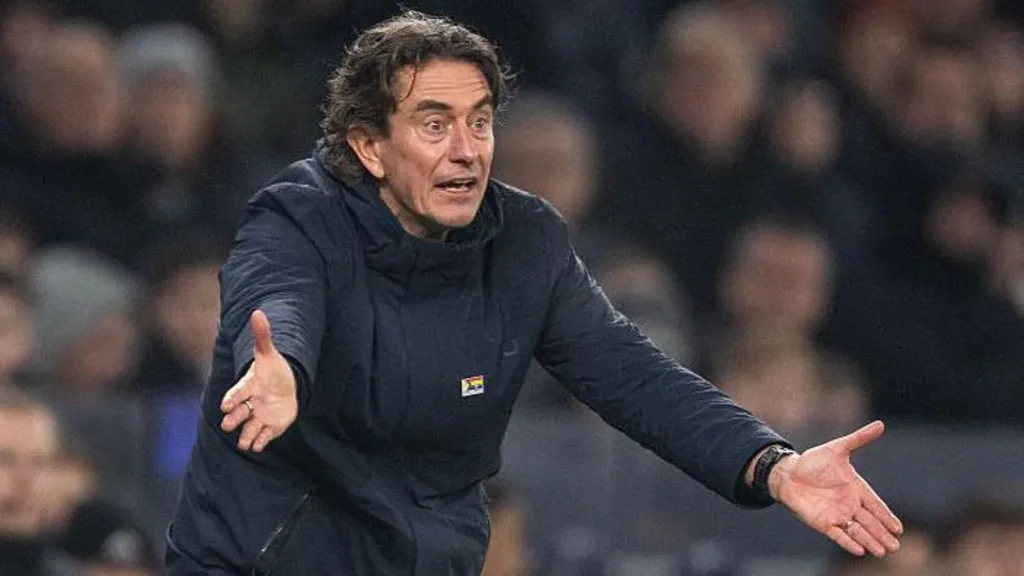
Tottenham has parted ways with manager Thomas Frank, ending his eight-month stint at the helm, with BBC Sport’s Sami Mokbel set to examine his time in the role.
The decline of Thomas Frank: An examination of his struggles to win over players and fans at Tottenham
Following Tuesday's defeat to Newcastle, Tottenham's decision to terminate Thomas Frank's contract was made swiftly, with the club's leadership acting promptly.
The call to sack Frank was made jointly by chief executive Vinai Venkatesham and sporting director Johan Lange, a decision that the club had been hesitant to make but ultimately deemed necessary.
Given the team's poor performance this season, even Frank's most ardent supporters could not argue against the decision to let him go.
On Wednesday morning, Venkatesham presented his recommendation to the Lewis family, the club's owners, to part ways with Frank, marking a significant turning point.
In recent weeks, Tottenham's fans had been vocal in their discontent, with many directing their frustration towards the club's ownership, who were perceived as being out of touch with supporters' views on Frank.
However, sources close to the ownership suggest that this was not the case, and the Lewis family was indeed aware of the widespread dissatisfaction among fans regarding Frank's tenure.
It would have been challenging for the ownership to ignore the intense ill feeling towards Frank, which had been building over recent weeks.
Having appointed Venkatesham as chief executive the previous summer, the ownership had effectively given him autonomy to run the club, and as such, they did not intervene, preferring to let decisions be made at the operational level.
When Venkatesham's recommendation to terminate Frank's contract arrived, the ownership board promptly approved the decision, bringing an end to Frank's tenure.
The formalities of Frank's departure were completed on Wednesday morning, with Venkatesham and Lange informing him of the decision in a meeting.
Frank's appointment in June had been viewed as a shrewd move at the time, given his impressive track record at Brentford.
During his time at Brentford, Frank had achieved significant success, earning promotion to the Premier League and subsequently consolidating the team's position in the top tier.
However, his stint at Tottenham was short-lived, lasting just eight months, and was marked by player discipline issues, divisions within the executive team, and questions over his tactical approach.
The gamble of appointing Frank at Tottenham ultimately ended in disappointment
Thomas Frank's tenure at Tottenham came to an end after just eight months, with the club deciding to sack him
Tottenham parted ways with Thomas Frank, bringing an end to his brief spell in charge
One of the key factors behind Frank's appointment was his ability to foster a positive culture, which he had successfully implemented during his time at Brentford.
However, there were instances where Frank's efforts to establish a respectful working environment were put to the test, particularly when dealing with player indiscipline.
Early in his tenure, Frank had dropped a player from the starting lineup after the player had reported late to a pre-match meeting and failed to apologize for the infraction.
The player later apologized, and Frank's handling of the situation impressed some of the players, who appreciated the fact that there were consequences for poor behavior.
Frank's approach to discipline was exemplified when he left Yves Bissouma behind for the Uefa Super Cup match against Paris St-Germain due to the player's persistent lateness.
More recently, Frank had chosen not to strip Cristian Romero of the captaincy, despite the defender's social media outbursts against the club and his red card in a match against Manchester United.
Romero was reportedly more challenging to manage at the training center, and some players felt that he received preferential treatment.
When Micky van der Ven and Djed Spence appeared to refuse to shake Frank's hand after a defeat to Chelsea, the manager downplayed the incident, stating that the players were simply frustrated, and later revealed that they had apologized.
Frank's player-centric approach was appreciated by some members of the squad, who felt that he prioritized their needs.
However, not all players were impressed with Frank's management style, and some had reservations about his leadership.
In the early stages of his tenure, some players perceived Frank as indecisive, which was a departure from the more assertive leadership style of his predecessor, Ange Postecoglou.
Postecoglou's personality had been a significant factor in the team's dynamics, although he had become increasingly isolated towards the end of his tenure.
There were also concerns among players regarding Frank's tactical approach, with some feeling that he was too focused on adapting to the opposition rather than imposing Tottenham's own strengths.
These concerns ultimately contributed to the perception that the Tottenham job was too big for Frank to handle.
The narrative surrounding Frank's departure will likely be shaped by his inability to assert himself and impose his vision on the team.
Thomas Frank's final interview as Tottenham manager is available to watch
The concerns surrounding Frank's appointment had been lingering for months, with some executives questioning his ability to lead the team.
One leading executive had recommended sacking Frank after the 2-1 defeat to Fulham on November 29, which marked Tottenham's third consecutive loss.
At the time, Roberto de Zerbi, the former Brighton head coach, was suggested as a potential replacement, but the club chose to stick with Frank.
The decision to retain Frank was made despite the team's poor performance, and it is interesting to note that the club's leadership, led by Venkatesham, continued to support him until the end.
The appointment of Frank was initially led by Daniel Levy, Tottenham's former executive chairman, who had unexpectedly departed the club in September after 24 years.
The club's leadership group, led by Venkatesham, ultimately decided to part ways with Frank, marking the end of an era.
The decision to sack Frank was likely influenced by the club's poor performance, and the fact that the team had not responded to his management style.
Prior to Venkatesham's arrival as CEO last summer, the groundwork for a significant deal involving Frank had already been laid, with the executive playing a key role in its execution, which ultimately led to Frank's move across London.
Following Levy's departure, many expected Venkatesham to dismiss Frank due to the growing criticism from fans, which seemed like the most straightforward decision at the time.
However, Venkatesham's situation was more complex, as he was aware that firing Frank could boost his own popularity, but he chose not to take that route.
A significant factor in Venkatesham's decision was the influence of Lange, who had been instrumental in identifying Frank as a top candidate and was a close ally of the Danish coach.
In contrast, Fabio Paratici, Tottenham's former co-sporting director, now at Fiorentina, had reservations about Frank's suitability for the role.
The post-Levy era at Tottenham has brought a sense of uncertainty, but also an opportunity for the club to establish stability after years of frequent managerial changes.
Venkatesham's experience at Arsenal, where he saw Mikel Arteta overcome adversity to lead the Gunners to success, likely informed his decision to stand by Frank, at least initially.
Tottenham's hierarchy believed that Frank had faced an unusually challenging campaign, with key players sidelined by injuries, which had hindered his ability to achieve consistent results.
The squad's need for repair, particularly in the wake of Harry Kane and Son Heung-min's departures, was another factor that Venkatesham and the club's leadership had to consider.
The departure of last season's top scorer, Brennan Johnson, was also a significant blow, although it was reportedly due to Frank's decision that the player was no longer part of his plans.
Tottenham's squad was also seen as lacking in leadership, which led to the signing of experienced players like Conor Gallagher and the attempted recruitment of Andy Robertson.
The home defeat to West Ham on January 17 marked a turning point, as it irreparably damaged the foundations of Tottenham's faith in Frank.
Sources suggest that the club was on the verge of ending Frank's tenure after that loss, which was attended by members of the Lewis family, including Vivienne Lewis, who was confronted by an angry fan.
Although Champions League victories over Borussia Dortmund and Eintracht Frankfurt provided a temporary reprieve, the subsequent loss to Newcastle extended Tottenham's winless league run to eight matches, ultimately sealing Frank's fate.
(No text available)
According to Alan Shearer, Frank's dismissal was necessary, as Tottenham were in danger of relegation.
Now, Venkatesham and the new leadership team face the task of making their first managerial appointment.
It remains to be seen whether they will opt for an interim manager with the intention of making a permanent appointment in the summer or choose a full-time manager immediately.
There is consideration behind the scenes for an interim solution, given the significant changes expected in the managerial landscape during the summer.
One possible option for the remainder of the season is John Heitinga, who recently joined Tottenham as an assistant coach and has managerial experience, including a stint at Ajax.
In the long term, Mauricio Pochettino's potential availability after the World Cup is an intriguing prospect, as he has expressed his desire to return to Tottenham.
Pochettino's potential return is a popular idea among fans, who have made their wishes clear, and it seems like a natural fit.
However, any potential appointment of Pochettino would have to wait until after the World Cup.
Other managers, such as Oliver Glasner, Andoni Iraola, and Marco Silva, will be available without compensation in the summer, providing alternative options.
Additionally, World Cup coaches like Thomas Tuchel, Carlo Ancelotti, and Julian Nagelsmann may also become available.
Given the array of options that will become available in the summer, it may be prudent for Tottenham to wait, but the recent availability of De Zerbi, who left Marseille, could also be an attractive option.
De Zerbi is seen as a manager who can make an immediate impact, which is something Tottenham could benefit from, given their current struggles.
Although De Zerbi can be volatile, his ability to hit the ground running makes him an interesting candidate for a club in need of a swift turnaround.
Sources indicate that Tottenham aim to have a new manager in place by the time the players return from their five-day break on Monday.
Amid the on-field struggles, the club's hierarchy must also address off-field rumors, including speculation about a potential sale of the club.
Despite these rumors, it has been reinforced to staff that Tottenham is not for sale, which aligns with the public messaging from the club, despite industry rumors suggesting the Lewis family may be open to selling.
Amanda Staveley, the former owner of Newcastle, has been linked with a continued interest in purchasing Tottenham, despite a statement in September denying any intention to make a formal offer.
Other consortiums, including groups from the USA, have also been linked with a potential interest in buying the club, while there were reports that Levy was considering selling his stake in Tottenham after his departure.
The combination of on-field struggles and off-field uncertainty has created an air of instability around the club.
For now, the focus is on finding a replacement for Frank and restoring stability to the team.
(Latest Tottenham news and analysis)
(Opportunity for readers to ask questions about Tottenham)

News
GB men’s curling team suffers upset defeat to Italy
At the 2026 Winter Olympics, Great Britain’s men’s curling team mounted a comeback against Italy following a disappointing beginning, ultimately falling short in their inaugural match.
Despite a valiant comeback, Team GB ultimately fell short as Italy held their composure to secure the win in the final end.
A dismal start to the match proved costly for Team GB's men, as they suffered their first defeat of the Winter Olympics at the hands of host nation Italy, despite a spirited fightback in the packed Cortina Curling Stadium.
Following victories in their first two matches, including a win over the Swedish rink that beat them in the gold-medal match four years ago, Team GB entered their second high-profile encounter in as many days in a confident position.
However, a disastrous opening end, in which Italy stole four points, left Team GB trailing and facing an uphill battle in front of a boisterous home crowd.
The British team, currently ranked number one in the world, gradually regained their footing and managed to level the score by the ninth end.
Ultimately, Italy maintained their composure in the final end to emerge victorious, winning 9-7 and adding Team GB to their list of scalps, which already included the Swedes.
"We had to dig deep and play some solid curling, but unfortunately, it wasn't enough to get us over the line," Team GB lead Hammy McMillan said in an interview with BBC Sport.
With seven wins from nine round-robin matches guaranteeing a spot in the semi-finals, Team GB remains in a strong position, although fewer wins may still be sufficient to advance.
The women's team is set to take to the ice next, facing South Korea in their second match at 13:05 GMT, while the men will return to action on Saturday against the Czech Republic at the same time.
Team GB is at the forefront of curling's technological advancements.
Embracing what sets you apart can be a powerful asset, according to some athletes.
A daily guide to the Winter Olympics is available for those looking to stay up-to-date with the action.
The looks of shock on the faces of Team GB's curlers told the story of a disastrous opening end.
With a stone in play, Mouat attempted a risky shot in an effort to claim two points, but it backfired, resulting in none of Team GB's stones in the house and four Italian stones in position.
However, the Scottish quartet, ranked number one in the world, quickly regained their composure and got back to their game.
The teams exchanged singles before a impressive final throw by Mouat, aided by a measurement to determine which stone was closest to the button, allowed Team GB to claim two points and narrow the gap to 5-3.
Another excellent team effort, which included a well-judged throw by Mouat, a solid sweep by Hammy McMillan and Bobby Lammie, and Grant Hardie's strategic expertise, forced Italy to concede a point in the fourth end, reducing the deficit to a single point at the break.
Italy blanked the sixth end and added two points in the seventh to rebuild their lead, but Team GB fought back with two points of their own, remarkably levelling the score with one end remaining after a steal.
The match came down to the final end, but Italy held their nerve to secure the win, prompting a deafening roar from the crowd.
"It's an incredible experience, and we need to get used to it," McMillan added, describing the electric atmosphere as "surreal" and "cool," more akin to a football match than a typical curling crowd.
News
Scotland Kicks Off Nations League Against Slovenia
Uefa has released the schedule for the Nations League, with Scotland set to begin their campaign on 26 September with an away match against Slovenia.
Uefa has released the schedule for the Nations League, with Scotland's campaign set to begin on 26 September with an away match against Slovenia.
The team's six group stage games will be played within a three-month period, culminating in a match against Switzerland on 16 November.
The fixture list was announced following Thursday's draw, which placed Scotland in a group with Switzerland, Slovenia, and North Macedonia.
Having been relegated from League A after a play-off loss to Greece last year, Scotland will compete in the second tier of the Nations League this year.
In response to the draw, head coach Steve Clarke noted that the teams in the group appear to be evenly matched.
Clarke reflected on the team's past experience in the competition, stating that it has been beneficial for Scotland.
He emphasized the importance of the Nations League, citing its role in helping the team qualify for Euro 2020, and anticipated a challenging set of matches.
A key matchup in the Nations League will see Scotland face off against Switzerland.
The group stage will determine the teams' fates, with the winner earning promotion, the runner-up entering a play-off, the third-placed team facing a relegation play-off, and the fourth-placed team being relegated directly.
The upcoming group games will mark a reunion for Scotland and Switzerland, who previously drew 1-1 in Cologne at Euro 2024.
Scotland's last encounter with Slovenia was during the 2018 World Cup qualification campaign, when they won 1-0 at home and drew 2-2 away.
The team has not played North Macedonia since the 2014 World Cup qualifiers, when they drew 1-1 at home and won 2-1 away, with goals from Ikechi Anya and Shaun Maloney.
The schedule for Scotland's Nations League campaign begins on 26 September with a match against Slovenia.
The team will then host Switzerland on 29 September, followed by a trip to face North Macedonia on 3 October.
Scotland will then play Slovenia at home on 6 October, before hosting North Macedonia on 11 November.
The final group stage match will see Scotland travel to face Switzerland on 16 November.
The team's home match against North Macedonia is set for 11 November.
The campaign will conclude with an away match against Switzerland on 16 November.
News
Golfer McIlroy Sinks Bunker Shot at Pebble Beach Pro-Am
At the AT&T Pebble Beach Pro-Am in California, Rory McIlroy achieved an eagle on the 14th hole at Spyglass Hill, capping off his opening round with a score of 68.
During the AT&T Pebble Beach Pro-Am in California, Rory McIlroy achieved an eagle on the 14th hole at Spyglass Hill, contributing to his first-round score of 68.
For further information, Rory McIlroy had a solid opening round, while Hisatsune took the lead.
Access to this content is restricted to users in the United Kingdom.
-
 News8 hours ago
Australian Politics Faces Questions Over Gender Equality Amid Sussan Ley’s Appointment
-
 News5 hours ago
Farage Says Reform to Replace Traditional Tory Party
-
 News5 hours ago
Wrexham Pair Seek Win Against Former Team Ipswich
-
 News11 hours ago
Liberal Party Removes Australia’s First Female Leader
-
 News9 hours ago
UK Braces for Cold Snap with Snow and Ice Alerts Expected
-
 News5 hours ago
Husband’s alleged £600k theft for sex and antiques blamed on drug side effects
-
 News2 days ago
Sunbed ads spreading harmful misinformation to young people
-
 Business11 hours ago
BBC Reporter Exposed to Cyber Attack Due to Vulnerabilities in AI Coding Tool