
News
North east experiences extreme weather pattern of blizzards, thaw, and rain
Scotland’s north east experienced significant snowfall during the initial 10 days of the year, followed by persistent rainfall that has continued with minimal respite.
Scotland's north east has experienced a significant amount of precipitation since the start of 2026, with heavy snow falling in the first 10 days of the year, followed by persistent rainfall.
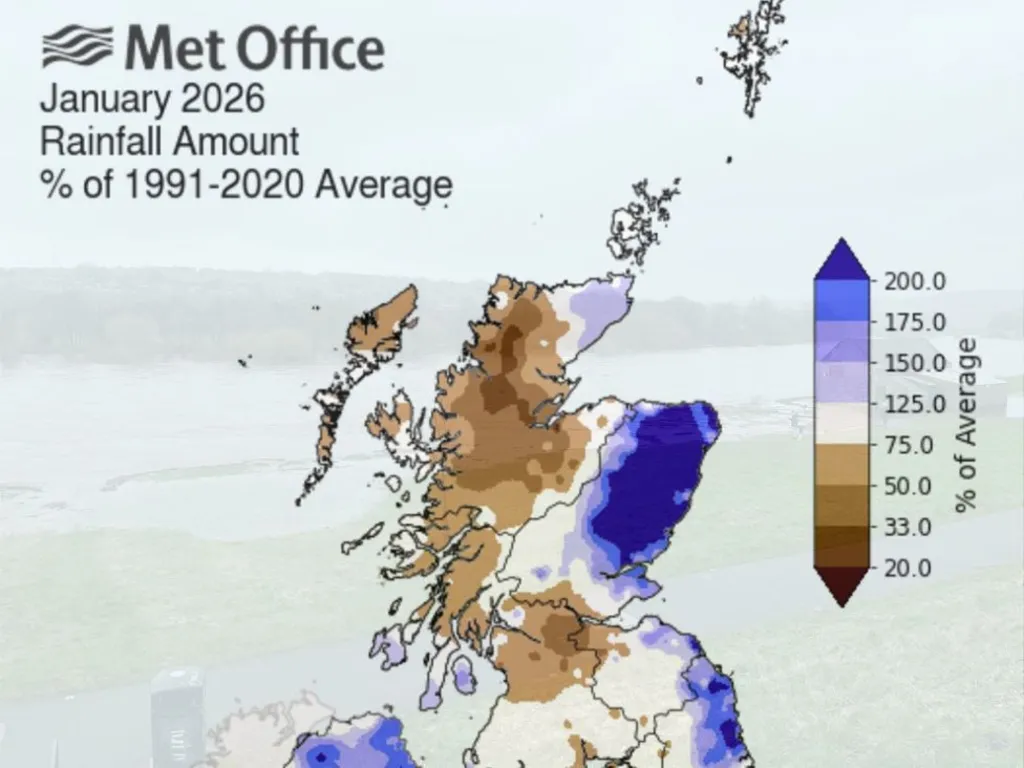
Aboyne, a town in Aberdeenshire, received over 277mm of rain in January, which is approximately four times the average monthly rainfall.
In Aberdeen, a record has been set for the longest period without reported sunshine, with no sun seen since January 21, surpassing any previous sunless period since Met Office records began in 1957.
The prolonged rainfall has had a wide-ranging impact, affecting various sectors such as football, the oil industry, agriculture, and road maintenance.
The question on many people's minds is what is causing this prolonged period of rainfall.
According to experts, a "blocked weather pattern" is to blame for the persistent rain.
This weather pattern has prevented significant movement in the jet stream, limiting the possibility of more settled and dry conditions.
Climate change is also a contributing factor, as it can lead to more intense rainfall events.
Met Office data suggests that a 1.5C increase in temperature could result in up to 16% more winter rainfall in Aberdeen and 13% more in Aberdeenshire, compared to the 1980s and 90s.
For Aboyne, this January has been the wettest on record since 1989.
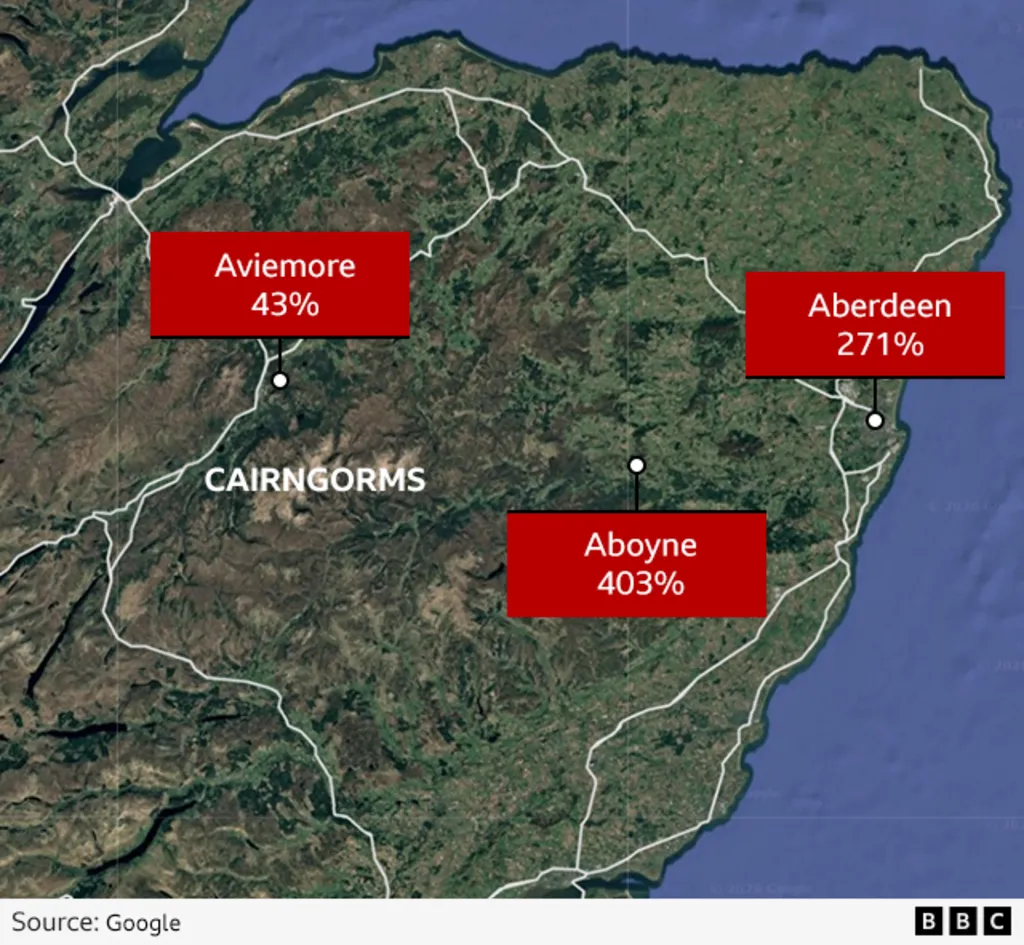
In contrast, Aviemore, located 40 miles west of Aboyne, experienced less than half its average January rainfall.
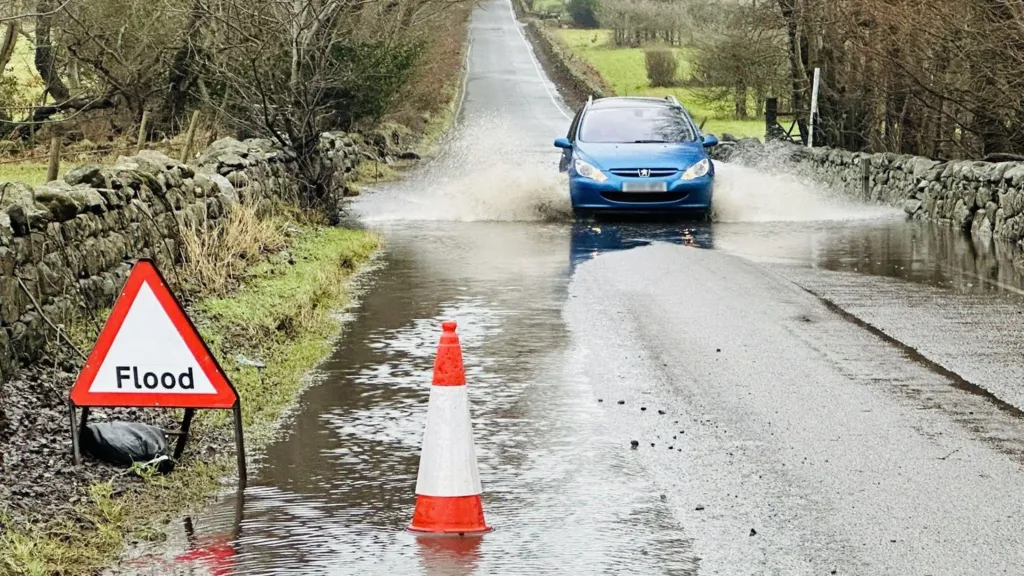
The continuous heavy rainfall, often accompanied by strong winds, has had a significant impact on various aspects of life in the north east of Scotland.
Several North Sea oil companies have evacuated staff from their installations due to the challenging weather conditions, which have hindered supply efforts.
Aberdeenshire Council has found it difficult to repair potholes due to the ongoing weather warnings and flood alerts.
The council stated that the region is experiencing persistent heavy rainfall, leading to localized flooding and affecting parts of the road network.
The council advised residents to exercise caution when traveling, urging them to drive according to the conditions and heed road closure signs.
The severe weather has also affected wildlife, with puffins struggling to survive due to a lack of food, resulting in deaths and rescues.
The heavy rain has also disrupted sports events, including the postponement of Celtic's Scottish Premiership match against Aberdeen.

Celtic expressed regret over the late postponement of the match, sympathizing with fans who had already begun their journeys or arrived in Aberdeen.
The club emphasized the need for earlier decision-making regarding match postponements.
The postponement of Aberdeen's Scottish Cup match against Motherwell was also announced.
Despite the weather, Aberdeen's Spectra festival of light is proceeding, with organizers encouraging attendees to dress warmly and enjoy the event.
Kevin Gilbert, the north east chairman of NFU Scotland, stated that the record rainfall is having a significant impact on farmers.
Gilbert, who farms near Kintore in Aberdeenshire, told BBC Scotland News that low-lying fields are completely submerged, and farmers are struggling to care for their livestock.
He explained that the prolonged rainfall is making it challenging for farmers to plan and work on their land.
Gilbert described the situation as "horrendous" and emphasized that the extreme weather is a significant challenge for farmers.
He noted that while farmers often complain about the weather, these extreme conditions are particularly difficult to manage.
The Scottish Environment Protection Agency (Sepa) reported issuing 81 local flood warnings in January.
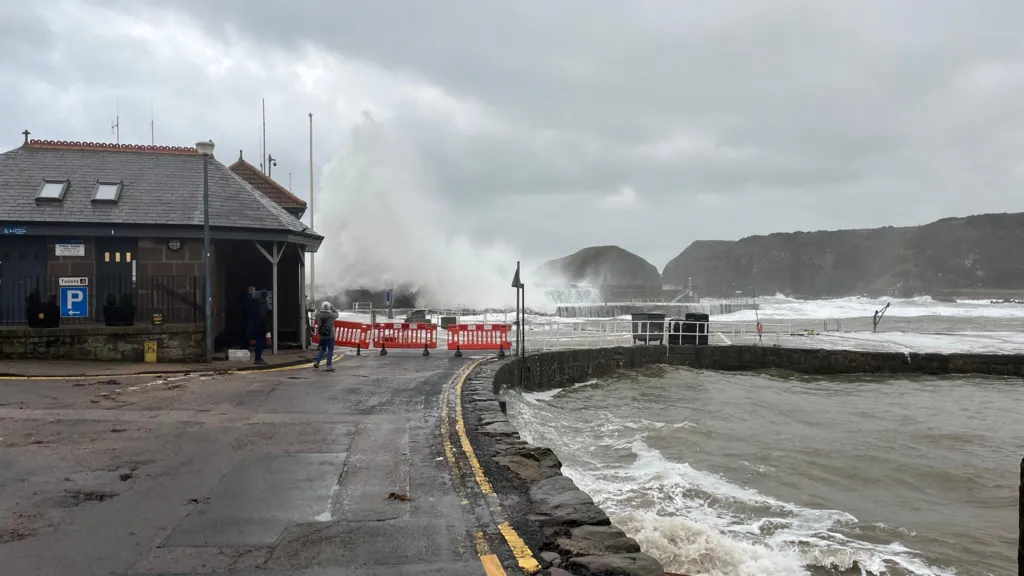
Sepa also stated that there are currently eight regional flood alerts and five local flood warnings in effect due to high tides and large waves along the east coast.
BBC Scotland Weather presenter Gillian Smart said that the weather outlook remains unsettled.
Smart explained that while wet and wintry weather is common in Scotland during January, this year's weather has been remarkable due to a blocked weather pattern.
She noted that the jet stream has been strengthened by cold conditions in North America, propelling Atlantic low-pressure systems towards Scotland.
At the same time, high pressure has become anchored over Scandinavia, creating a block that prevents weather systems from passing through and leading to persistent rain.
This pressure pattern has also brought persistent southeasterly winds to Scotland, resulting in the north east bearing the brunt of the rain and snow.
Smart explained that the ground is not getting a chance to dry out between weather systems, so even moderate rainfall is causing further flooding and disruption.
She forecasted blustery east winds and further rain for eastern Scotland on Friday.
The weekend is expected to bring an easing of the winds for most of Scotland, although it will remain blustery in the Northern Isles and north eastern coasts.
Smart predicted that the following week would bring a chance of more significant snowfall as the air turns colder.
The weather pattern is expected to continue, with plenty of cloud and patchy rain, and any snow confined to the mountains.
The prolonged period of rainfall is likely to continue, with no significant change in the weather pattern expected in the near future.
University of Glasgow's Prof Hester Parr, a cultural geographer, focuses her research on Seasonal Affective Disorder (SAD), a condition that affects many during certain times of the year.
According to Prof Parr, the weather has a unique impact on each individual, influencing their mood and behavior in distinct ways.
For those who experience severe depression during specific periods, such as winter, Prof Parr notes that this can be characteristic of seasonal affective disorder, which has a profound effect on their mental wellbeing.
Prof Parr predicts that people will be spending more time indoors, leading to what she terms "wet lives," which can have negative consequences for mental health.
During periods of bad weather, many people tend to isolate themselves, staying indoors with curtains closed, but Prof Parr warns that this can exacerbate mental health issues, rather than alleviate them.
Establishing a daily routine that incorporates outdoor activities and exposure to natural light can have a positive impact on mental health, increasing energy levels and improving mood, according to Prof Parr.
By venturing outdoors, individuals can discover that their surroundings are not as bleak as they seemed, and that even on the cloudiest days, there is still an abundance of natural light to be found.
Prof Parr emphasizes that spending time outside, even on the darkest days, can be highly beneficial for mental health, as it allows individuals to tap into the natural light available in their environment, which can have a profound positive effect.

News
GB men’s curling team suffers upset defeat to Italy
At the 2026 Winter Olympics, Great Britain’s men’s curling team mounted a comeback against Italy following a disappointing beginning, ultimately falling short in their inaugural match.
Despite a valiant comeback, Team GB ultimately fell short as Italy held their composure to secure the win in the final end.
A dismal start to the match proved costly for Team GB's men, as they suffered their first defeat of the Winter Olympics at the hands of host nation Italy, despite a spirited fightback in the packed Cortina Curling Stadium.
Following victories in their first two matches, including a win over the Swedish rink that beat them in the gold-medal match four years ago, Team GB entered their second high-profile encounter in as many days in a confident position.
However, a disastrous opening end, in which Italy stole four points, left Team GB trailing and facing an uphill battle in front of a boisterous home crowd.
The British team, currently ranked number one in the world, gradually regained their footing and managed to level the score by the ninth end.
Ultimately, Italy maintained their composure in the final end to emerge victorious, winning 9-7 and adding Team GB to their list of scalps, which already included the Swedes.
"We had to dig deep and play some solid curling, but unfortunately, it wasn't enough to get us over the line," Team GB lead Hammy McMillan said in an interview with BBC Sport.
With seven wins from nine round-robin matches guaranteeing a spot in the semi-finals, Team GB remains in a strong position, although fewer wins may still be sufficient to advance.
The women's team is set to take to the ice next, facing South Korea in their second match at 13:05 GMT, while the men will return to action on Saturday against the Czech Republic at the same time.
Team GB is at the forefront of curling's technological advancements.
Embracing what sets you apart can be a powerful asset, according to some athletes.
A daily guide to the Winter Olympics is available for those looking to stay up-to-date with the action.
The looks of shock on the faces of Team GB's curlers told the story of a disastrous opening end.
With a stone in play, Mouat attempted a risky shot in an effort to claim two points, but it backfired, resulting in none of Team GB's stones in the house and four Italian stones in position.
However, the Scottish quartet, ranked number one in the world, quickly regained their composure and got back to their game.
The teams exchanged singles before a impressive final throw by Mouat, aided by a measurement to determine which stone was closest to the button, allowed Team GB to claim two points and narrow the gap to 5-3.
Another excellent team effort, which included a well-judged throw by Mouat, a solid sweep by Hammy McMillan and Bobby Lammie, and Grant Hardie's strategic expertise, forced Italy to concede a point in the fourth end, reducing the deficit to a single point at the break.
Italy blanked the sixth end and added two points in the seventh to rebuild their lead, but Team GB fought back with two points of their own, remarkably levelling the score with one end remaining after a steal.
The match came down to the final end, but Italy held their nerve to secure the win, prompting a deafening roar from the crowd.
"It's an incredible experience, and we need to get used to it," McMillan added, describing the electric atmosphere as "surreal" and "cool," more akin to a football match than a typical curling crowd.
News
Scotland Kicks Off Nations League Against Slovenia
Uefa has released the schedule for the Nations League, with Scotland set to begin their campaign on 26 September with an away match against Slovenia.
Uefa has released the schedule for the Nations League, with Scotland's campaign set to begin on 26 September with an away match against Slovenia.
The team's six group stage games will be played within a three-month period, culminating in a match against Switzerland on 16 November.
The fixture list was announced following Thursday's draw, which placed Scotland in a group with Switzerland, Slovenia, and North Macedonia.
Having been relegated from League A after a play-off loss to Greece last year, Scotland will compete in the second tier of the Nations League this year.
In response to the draw, head coach Steve Clarke noted that the teams in the group appear to be evenly matched.
Clarke reflected on the team's past experience in the competition, stating that it has been beneficial for Scotland.
He emphasized the importance of the Nations League, citing its role in helping the team qualify for Euro 2020, and anticipated a challenging set of matches.
A key matchup in the Nations League will see Scotland face off against Switzerland.
The group stage will determine the teams' fates, with the winner earning promotion, the runner-up entering a play-off, the third-placed team facing a relegation play-off, and the fourth-placed team being relegated directly.
The upcoming group games will mark a reunion for Scotland and Switzerland, who previously drew 1-1 in Cologne at Euro 2024.
Scotland's last encounter with Slovenia was during the 2018 World Cup qualification campaign, when they won 1-0 at home and drew 2-2 away.
The team has not played North Macedonia since the 2014 World Cup qualifiers, when they drew 1-1 at home and won 2-1 away, with goals from Ikechi Anya and Shaun Maloney.
The schedule for Scotland's Nations League campaign begins on 26 September with a match against Slovenia.
The team will then host Switzerland on 29 September, followed by a trip to face North Macedonia on 3 October.
Scotland will then play Slovenia at home on 6 October, before hosting North Macedonia on 11 November.
The final group stage match will see Scotland travel to face Switzerland on 16 November.
The team's home match against North Macedonia is set for 11 November.
The campaign will conclude with an away match against Switzerland on 16 November.
News
Golfer McIlroy Sinks Bunker Shot at Pebble Beach Pro-Am
At the AT&T Pebble Beach Pro-Am in California, Rory McIlroy achieved an eagle on the 14th hole at Spyglass Hill, capping off his opening round with a score of 68.
During the AT&T Pebble Beach Pro-Am in California, Rory McIlroy achieved an eagle on the 14th hole at Spyglass Hill, contributing to his first-round score of 68.
For further information, Rory McIlroy had a solid opening round, while Hisatsune took the lead.
Access to this content is restricted to users in the United Kingdom.
-
 News8 hours ago
Australian Politics Faces Questions Over Gender Equality Amid Sussan Ley’s Appointment
-
 News5 hours ago
Farage Says Reform to Replace Traditional Tory Party
-
 News5 hours ago
Wrexham Pair Seek Win Against Former Team Ipswich
-
 News11 hours ago
Liberal Party Removes Australia’s First Female Leader
-
 News9 hours ago
UK Braces for Cold Snap with Snow and Ice Alerts Expected
-
 News5 hours ago
Husband’s alleged £600k theft for sex and antiques blamed on drug side effects
-
 News2 days ago
Sunbed ads spreading harmful misinformation to young people
-
 Business11 hours ago
BBC Reporter Exposed to Cyber Attack Due to Vulnerabilities in AI Coding Tool